Friday, 8 April 2016

Training in the Hogan Tools

I have blogged before about the Hogan psychometric tools. Here is my first post on the subject, explaining my interest, and I reflect on my own learning from the legendary Dark Side questionnaire here.

As a result of this, along with recommendations from clients and coaches whom I respect, I have decided to organise a training and certification programme locally in the North West. I have already found a number of colleagues who wish to do this, so the course is booked. The group looks to be an exciting and dynamic one. I will spare their blushes, by not naming them and citing their many qualities... However, we have spaces for a few more, if anyone else is interested.

The Course will be run by PCL at Lowther Castle (in a room with a roof on!) which is just south of Penrith, on 12/13 July 2016, and the cost will be about £1400 (+VAT). The final figure will depend on the number of people attending, as we are sharing the costs of the venue and the trainer's expenses amongst us.

That is significantly less than the price of PCL's public certification programmes, and other benefits include 2 days in the Lake District, rather than having to travel and stay down South, and working with a small cohort of great local people, who can provide a continuing discussion and learning group afterwards.


For full details of the tools, see here. 

If you are interested, or know anybody who might be, please get in touch!

Saturday, 2 April 2016

The Thinking Partnership Programme

Further to my recent posts about Nancy Kline's work (here and here), I have been on her Thinking Partnership Programme this week, and thought it would be interesting to record my initial reflections.

I should say that I have done days 1 and 2 of a 3 day programme - the third day is in May, when we have had the chance to practice and reflect on our learning from days 1 and 2.


The first thing to record is that it was a hugely enjoyable two days. Nancy (in green in my photo) was excellent, and the other participants on the course, Claudia, Colm, Jenny and Lars were fun and stimulating company. And the venue, Friars Ford in Goring was delightful, too. 

And then there was the content. We had plenty of practice, including rounds, paired work with other participants, and demonstration thinking partner sessions with Nancy working with each of us (except Colm - his turn will come next time) individually whilst the others observed.

We also had plenty of time for discussion, questions and laughter.

A number of things struck me. First of all, there is the power of the work. It seemed evident in all cases that the approach Nancy advocates is very powerful (and see below for comments around my gullibility and confirmation bias etc). Nancy, of course, is a highly skilled practitioner who demonstrates what may best be described as profound simplicity.

The rounds were highly effective; simply ensuring that each person present has the time to speak, with others' full attention on them (and thus no interruption), ensured that everyone arrived, and also connected with everyone else, quickly and simply. Nancy's clear explanation of what to do, including the need to be brief in fairness to all (and in the first round, to focus on something that is going well), was very helpful. I foresee starting many, if not all, of my future meetings like this.

The paired sessions, when we worked with other participants, practicing generative listening, were also powerful. In just five minutes, I got new insights into a problem that I have been worrying away at unsuccessfully for a while, or new ideas about a topic I had not given sufficient thought to until then. Likewise, practicing the listening was valuable: having the privilege of hearing others taking their thinking further, and recognising, once again, just how powerful attention is, in enabling the other person's brain to do its best work.

That was even more evident in the longer sessions when Nancy demonstrated the complete Thinking Partnership process. Each of us found that a very powerful session; and it was deceptive how little Nancy appeared to have to do in order to draw excellent - and new - thinking out of each of our brains. Of course, she was doing a lot; it was just that she said very little.

The process outlined in the books - the listening, and listening again, and listening again, followed (but only if necessary) by asking for the goal for the session, and then identifying and removing limiting assumptions with the Incisive Question - really works. 

I was also fascinated to see how Nancy treated a direct request for her views. She pointed out the danger of infantilising the thinker if one suggests a course of action; instead, she clearly and simply shared some relevant experience, allowing the thinker (Claudia, in this case) to make of it what she would. I learned a lot from watching that, and from Nancy's explanation.

In fact, her continued emphasis on avoiding anything that might risk infantilising the thinker, by placing the thinking partner on a higher plane in any way, has made me re-consider some of my own practice. For example, I always ask a coaching client at the end of a session what he or she plans to do. I always ask him or her to complete and return a Success Report. But should I? Should these be, at most, options available, rather than requirements?

As well as the practical sessions, I learned a lot from the discussions in between, and indeed the conversations over lunch and breaks.

Of particular interest to me was the synthesising of Nancy's (deceptively) simple approach with my interest in neuropsychology. I have blogged before about my learning from books like Neuropsychology for Coaches, and also about my concern that I (and other trainers) may be particularly susceptible to plausible but unproven (or even disproven) approaches (here). So I was fascinated to learn that Paul Brown, who co-authored Neuropsychology for Coaches had attended the programme, and what he made of it. 

Nancy told us that he had been both impressed and puzzled at the consistently reliable way in which the approach worked, in ways which he only sometimes managed to achieve in his own professional practice as a therapist. His theory, on reflecting on this, is that the components of the Thinking Environment quieten the amygdala, so that it releases the approach hormones (rather than the fight/flight hormones triggered, for example, by interruptions, urgency etc). These provide the best neural context for the brain to do its best thinking. 

That is clearly a hypothesis at present, and needs further research; but it is a plausible hypothesis that makes sense of the evidence, from a credible source.

Of course, questions remain. And I am glad, or there is a risk that day 3 would be less stimulating (though actually, I don't think that would be a real risk, even if I had no questions). But also, I am glad because I think we should always be questioning our practice and understanding.

The three that are at the top of my mind at present are ethics, permanence and the Positive Philosophical Choice.  The ethical questions arise from the non-directive nature of the process. The thinker is trusted to make the right meanings and come to the right conclusions; and that is clearly an important and powerful part of the process. But what if the thinker is pursuing a goal that is ethically unacceptable?  I think we will return to that on day 3.

Permanence is my biggest practical question. I recognise that the Incisive Question helps the thinker to replace an untrue limiting assumption with a true, positive one. But for how long? I am not sure if it is only intended to be for the duration of the thinking session, in order that new thoughts may be generated; but if so, that allows the old assumption to resume its dominance, which seems a shame. But if it is intended to over-write the old assumption permanently, I am concerned the approach underestimates the power of habits of thought, environmental and social stimuli, and so on. So that is another conversation I look forward to having on day 3.

And then there is the underlying philosophy: the Positive Philosophical Choice, as Nancy calls it. I quite accept that this is a very valuable working assumption. But what happens in those rare cases when one meets the genuine sociopath, for example? Again, a question I look forward to discussing on the final day of the programme.

So overall, I learned a great deal, was hugely impressed both with Nancy and her work, and would highly recommend the programme to anyone who wants to help others to think at their very best.

And I am looking forward to day 3 enormously.


Friday, 1 April 2016

Charity Miles and Charity Photos

I blogged a little while ago about Charity Miles. It is such a simple and brilliant idea. So far this year, just by walking the dog, going for a run in the morning, and longer walks at weekends and during the Easter break, I have raised $77.96 for Charity Water.

I have also told many other people about it, some of whom were similarly enthused (at least to my face) so I hope that they too are taking money from the likes of Johnson and Johnson, and giving it to worthwhile good causes.

But more recently, I have started using the Donate a Photo app. That one is even simpler: you upload a photo, and they (Johnson and Johnson) give a dollar to a charity. What's the catch? You can only donate one photo a day. So that means that if you do it all year, you have transferred $365 from J&J to a charity of your choosing (from quite a good list of choices.)  I am giving to Operation Smile, which provides free surgery for children with cleft lips.

So if you have a smartphone, download the apps, and help redistribute wealth from large corporations to charities doing some real good in the world!

Tuesday, 29 March 2016

That Book

The book is practically finished: ie it is now proof-read, and indexed. We are just awaiting the final graphics.

The cover may (will not - see Update below)  be based on either of these:


The publication date is 28th October of this year, and the publisher is Matador. The isbn will be 9781785893551, though I don't think that will do much for you yet... Fear not, I will be reminding everyone as soon as the book is actually available.

To help you while away the idle hours until you can get your hands on a copy, here is a link to the radio interview I did about the book with Karen Ainley, as part of the recent media training we were running together, about which I blogged here.

You may also choose to attend this years University Forum for Human Resource Development Conference at which I will be speaking about the ideas in the book on 8 June (15.40 in the Coaching stream).


UPDATE

The cover has been revealed (to me) and is much better than these early ideas! But I think I'll keep it under wraps for a little longer...)

Monday, 21 March 2016

More Time To Think

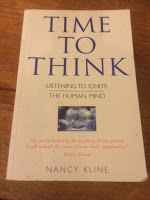
I have blogged before about Nancy Kline's book, Time to Think, and its underlying philosophy. As I made clear in that post, I am enthused about her approach, so I have booked on to her Thinking Partnership workshop, which I am attending next week (with Nancy, not one of the other licensed providers). I will report back in due course...

In the meantime, I have been reading her sequel, More Time to Think. This expands on, and to some extent updates, the previous work; and in particular has a good section on coaching, including some suggestions for the initial exploratory meeting with a new coaching client.

I was particularly interested in this as I had already identified, through conversations in supervision, that I wished to improve my initial meetings.  Kline's approach is simple, as one might expect, but also profound, as one also might expect.

She rightly points out that the two topics of conversation are what the individual wants from coaching, and how the coach coaches. I had already got that far in my previous version of the initial meeting. However, I recently conducted my first 'Kline-by-the-book' initial session, and it was very much better than my previous ones. 

So what have I changed as a result of reading More Time to Think?  There are a few things.

One is that I asked each question (such as 'What are your goals for this coaching?') several times. Even when I was pretty sure, and indeed the client had indicated, that he had said all he had to say, I asked it one more time; and to the surprise and delight of both of us, more good thinking flowed.  

The second is that I did not take any notes. This was a bit of a wrench for me, as I mistrust my memory; but the benefits outweighed that: in particular the quality of attention I was able to give him, and the ease of the whole session for him and for me. I asked a total of nine questions (each one several times) and that part of the conversation lasted for about an hour and fifteen minutes, with him doing 95% of the talking. The results of that were much greater clarity around, and commitment to, both the overall goals of the coaching, and the milestones along the way. I also got a far deeper understanding of the client and his context.

The third is that I worked particularly hard on my listening. My listening is normally good, but I can be tempted to join in the conversation. Instead, I refused that temptation consciously, and apart from reassuring noises (yes, uh-huh, etc), two summaries and the nine questions, I kept quiet, and really focussed on what the client was saying with utmost curiosity and delight.

Oddly (or perhaps not) I find that I did not need my notes to remember the conversation (though I made notes afterwards of the key ideas).

The other big change was the way in which I described, and we discussed, my role as a coach. I have blogged before about the way I describe my work in this context.  This time, I went down the route suggested by Kline, and said that my role was to help him to do his very best thinking; that he would be able to solve nearly all of his issues himself, and my job was to provide the support and stimulation for that to happen; and that I would only offer information or suggestions when we were both clear that his thinking had taken him as far as it could, and that he wanted more ideas. I talked him through the ten components of a Thinking Environment, and the underlying philosophy; and also discussed the need for feedback and honesty between us.

One more change: I got him to complete the relevant parts of the documentation: coaching goals, how we will check progress, and so on. He thought that was obviously his role (prior to this, it is something I have done after the meeting, working from my notes, and then sent back to the client to check). His observation was that it made sense for him to write the goals, both so that they were in his words, and as a practical act of commitment to them.  And it saved me a job.

We ended with mutual appreciation; which again was easier than I had thought it might be, due to the quality of listening, and the subsequent degree of interest and energy, I had invested in the process. 

So that feels like a successful initial session; not least modelling the fact that ownership and airtime both belong to him, and what my role is. 

I will certainly be using this approach again in my initial meetings; as well as being more rigorous in my using the rest of the Kline approach in future meetings, when it is appropriate.

Friday, 11 March 2016

Suzy Lamplugh Trust Update

For those who have been following the saga of my attempts to get the Suzy Lamplugh Trust to correct an (inadvertent, I am sure) error on their website, here is the latest instalment.

But before that, give me a second to bring new readers up to speed. I blogged a while back about the Mehrabian myth, the notion that  the words in a verbal communication account for  only 7% of the meaning we receive; the rest being voice (38%) and body language (55%).

I came across it again when being trained for the voluntary work that I do, and was told that the source of their (mis)information was the Suzy Lamplugh Trust. So I looked on the Trust's website and found  and they do not quote the figures there, but they do say  'The majority of communication is through body language, a lot through tone of voice and only a little through words.' (Their emphasis). I blogged about it here, including why it is so worrying in that context, and also wrote to the Trust.

In due course, I received a reply, which I thought might just be fobbing me off; so I resolved to re-visit the site after a while, and see if they had actually changed anything. They had not. So I wrote to the Chair of the Trustees, and this week received his reply.
Thank you for your email to me of 4th March. Having looked into this I really don't think that the information on the Trust's web-site is either misleading or dangerous. To the contrary, it is making an important and correct point: that body language is often more important than what one says and that it is important to be aware of one's body language if one is to defuse aggressive behaviour. As you have noted yourself, our web-site doesn't use the (often misquoted) Mehrabian percentages. Accordingly, I am satisfied that the responses you have previously received from the Trust's staff were appropriate and that they reflect the Trust's policy. I am grateful to you for bringing this issue to the Trust's attention. As a result of you doing so we have now reviewed this matter twice. However, we do not propose to review it again, at least not in the immediate future. Accordingly, we not intend to correspond with you further about this.
Beneath the formal courtesy, that sounds like a clear 'get lost.'  I note that at no stage has anyone from the Trust maintained that the statement is true, still less given any reference to support such an assertion.

However, never one to give up too lightly on helping people to learn, I tried one last shot:
Thanks for your email. I have no intention to waste your time, and do not expect a reply to this. 
However, I would point out that there is a vast difference between these two statements: 
 'The majority of communication is through body language, a lot through tone of voice and only a little through words.’
 'body language is often more important than what one says and [that] it is important to be aware of one's body language if one is to defuse aggressive behaviour.'
My only intention was to help you correct this inaccuracy - if you changed the wording on the site to what you wrote in your email, that would be telling the truth rather than telling an untruth. 
Perhaps it is my training as a linguist that makes this seem important to me. Try telling any student of a foreign language that 'The majority of communication is through body language,’ and you will see what I mean. 
I have little hope that it will do any good, but I will revisit their site occasionally, in the hope that the change will be quietly made.

And I continue to wish them well with the important work that they do.


If you agree with me that they should correct the site, you might choose to drop them a courteous line to that effect.  If you think I am wrong on this, you could drop me a line, of course.

Friday, 4 March 2016

Graphic Reporting

This week we ran another of our series of workshops thinking creatively about developing the Strategy at Cardiff University. This was focussed on the Learning and Teaching agenda, and was a very successful event. The element I want to focus on was the work of Eleanor Beer, who was there as our graphic reporter.

I've only once before worked with a graphic reporters like this, and I was struck by how powerful and valuable this is. Eleanor managed to summarise both the plenary sessions and the output from eleven syndicate groups in one large, colourful and clear poster.


This will both accompany the more formal report summarising the proceedings, and also be available as a stand-alone reminder for those who attended the event.

All of which made me wonder why I didn't do it more often. And the truth is that I was a little disappointed the first time.  The work produced then was less graphic and more heavily reliant on words; it also seemed, somehow, less additive. That is harder to analyse, but it felt as though the reporter was just catching the headlines, where Eleanor was capturing the spirit as well.


So I am re-enthused about the approach; but would also recommend selecting your graphic artist with real care, to ensure that you get the quality of output you want, rather than something that leaves you feeling disappointed.