Showing posts with label Learning. Show all posts

Tuesday, 4 June 2024

Learning from my grandson

One of the things people often say to me when learning new skills (you know, the really difficult things, like listening without interrupting...) is that it doesn't feel natural. The implication underlying this, I think, is that it therefore isn't very authentic.  And we all know that being authentic is (rightly) seen as an important trait for effective leadership and good interpersonal relations. (Though I think that needs a little unpacking, as I have written previously). 

However, I think that the description that new behaviour (such as refraining from interrupting) doesn't feel natural is, in fact, inaccurate. And that brings me to the title of this post: Learning from my grandson

Nate is not quite one year old, and has been learning to walk. At first, he was, understandably, not very good at it - he fell over a lot, and waddled in a rather unbalanced way. It didn't look (or, I dare guess feel) 'natural' in the sense used above.  But over the last few weeks he has got a lot better and charges around after his big brother quite easily, and only falls over occasionally.

And I dare guess that most of my readers regard walking as quite natural to them - you may well stroll from one side of the room to the other without falling over, or even hike over the fells, or wander down to the pub...

The point being, of course, that it is a learned behaviour; as indeed are almost all those behaviours which feel natural to us. For natural here is really a mis-label for habitual (or at least familiar). So when people tell me that it doesn't feel natural for them to refrain from interrupting (or whatever the new behaviour is) I refer to Nate and his learning to walk.  It takes practice, but with time they will get good at it, incorporate it into their repertoire of familiar (or even habitual) behaviours, and then it will indeed feel natural.


--

With thanks to DICSON for sharing this photo on Unsplash (Nate's parents prefer that we don't share his photo online).

Friday, 12 May 2023

I remember, I remember... (or maybe I don't)

 When I was in my early 20s I did one of those lifeline exercises: where you draw a line from birth to now, with ups and downs representing the highs and lows of life to date.  It was part of a course I was on, and I think we spent 20 minutes or so on it, and then looked for patterns or something (I don't really remember, to be honest).

But what I do remember very clearly is picking my lifeline up a few weeks later, and realising that I had not included the biggest down of my life so far: the death of my father when I was 17. Reflecting on that, I realised that threw light on how I had handled that great loss: I had not thought about it very much - I had banished it from memory. I suspect I had learned a child not to dwell on unpleasant emotions. That felt like a valuable insight, but I had not thought much about it in the intervening years: I had, to all intents and purposes, forgotten it.

But it came back to me recently, as I have been working on another development programme that asked me to reflect on times when I had been emotionally upset recently. I struggled to remember any: I see myself as being on a pretty even keel most of the time. But I asked Jane, my wise and perceptive wife, if she could remember any such times recently,  She said: 'Yes, this morning!' And as she explained what she was thinking about, I knew that she was right. 

I then realised both that I had failed to register that I was really cross about something (that had happened a while back, but which I was recounting to a friend that morning), and failed to remember that I had been at all animated about it, in telling my friend. Though on reflection (prompted by Jane) I realised that his response (which I had thought a little over the top) was pretty clear feedback that I was telling the story with strong emotional charge.

All of which reminded me of that earlier insight: that one way I deal with disruptive emotions, at least sometimes, is not to register or remember them. Not only that, but my memory more generally is pretty poor: when we start to watch an old film, Jane will remember instantly if we have ever seen it before, however long ago - whereas I can watch it through and still be surprised at the twist in the end...

That has some significant benefits, of course. It means that I am not prone to carrying emotional distress forward (or at least, not consciously) and that I rarely harbour grudges.  It also makes observing confidentiality very easy. But on the other hand, there are some distinct risks, including the risk of not learning from experience, and the risk of not connecting authentically with others.

I already have some strategies to address this, of course. I try to write up my notes of coaching sessions, events I have facilitated, etc very promptly; and I keep a reflective learning diary on a regular basis. But even here, I rarely comment on the emotional charge of events.  So that is my current work in hand, in terms of increasing my self awareness.

And I thought I had better write the intention down here, lest I forget it.

--

With thanks to Ivana Cajina and Marcos Paulo Prado for sharing their photos on Unsplash

Sunday, 16 October 2022

Neurodiversity and the Thinking Environment

Some time ago, I was introducing the idea of listening without interruption to a group of professors on a Professorial Leadership course.  I invited them to spend a few minutes at their tables taking turns to listen to each other think out loud about the questions: Who am I? and What do I want these colleagues to understand about me? - and to listen without interrupting or asking questions, but rather with real attention dedicated to the person speaking.

Overall, it worked well; most reported that it was a much better way of getting to know each other at the start of the programme than their usual experience; however, one professor told me that it didn't work well for her and wouldn't for other neurodiverse people. But time was against me having a further conversation with that professor at the time, and to my shame, I didn't follow it up later, so never knew precisely what she meant.

However, more recently,  I have been working more closely with someone who identifies as neurodiverse, and specifically as having ADHD; and I have also been talking with other Thinking Environment practitioners about their experience, and have some initial findings, which I share as much to provoke comment (and further learning for me) as to offer some clues to other practitioners with regard to some issues to consider.  These relate specifically to people with ADHD, not other neurodiverse people who will have a range of other issues worthy of consideration.

The first thing is that two of our favourite questions can be overwhelming; and in both cases that is because they are multiple questions.  Of course, when that was pointed out to me, I remembered from my early days of being trained in sales, and then working as a sales trainer myself, that we always tried to avoid multiple questions. Yet in a Thinking Environment, these two are often very productive:

What do you want to think about, and what are your thoughts?

What more do you think... or feel... or want to say?

I understand why we use these questions and why they often work; but it is worth considering if we should - at least for some people - separate them out.


Another question that can be overwhelming is: What might you be assuming that is stopping you from achieving your goal? (and all its variants).  In that case, it is the range of possibilities that is overwhelming; so whilst the question remains a good one, it can be helpful to preface it with permission to find it difficult: 'the next question I am going to ask you may feel a bit overwhelming; so take your time, and relax into it, and then answer when you are ready...'

For the role of Thinking Partner, the requirement to memorise the thinker's exact words (in order to build an Incisive Question, using  the further session goal and the limiting assumption) can be very challenging too, for some people with ADHD. It may be appropriate to flex our usual expectation of no note-taking in that very specific circumstance.

Further, some people with ADHD have felt excluded and marginalised by their previous experience of meetings and interviews, which may undermine their confidence and make them particularly worried that they may be starting with a deficit, so appreciation and self-appreciation are valuable.  

The good news is that some people with ADHD have reported the experience of the Thinking Environment as being very positive indeed. 'I felt smart, and welcomed, for practically the first time!'

I continue to think and enquire about this: if you have any relevant thoughts, feelings or experiences, please get in touch.  You can leave a comment here, email me, or use any of the contact details on my website.

Monday, 5 September 2022

The Art of Living Generously

Over the summer, I have been reading Give: Charity and the art of living generously, by Magnus Macfarlane-Burrow.  Who is he? He is the founder of Mary's Meals, a charity that provides one hot meal a day, at school, for some 2 million children who otherwise would not eat, and probably would not attend school either. This is a wonderful way to attend both to the giving a fish and the teaching to fish aspects of help.

Give is his reflections on what he is doing, and why; and the philosophy that he is developing around the work of charities, including reflections on what has gone wrong, so spectacularly, with some of the larger NGOs, and been exploited by politicians and the press to give overseas aid a bad name. 

I was particularly struck by his insistence that the minute we think of ourselves as better than those who are less fortunate, we are on the wrong path. And one of the dangers is that we then prioritise the efficiency and the effectiveness of our operation over compassion and companionship with actual people.

Working as I do with many Universities, I started to apply that to University administration: how easy it is to focus on recruitment targets, on ref results, and so on, with the risk of forgetting the individual student, or the individual researcher, or the people whom the research is designed to benefit.

And then I realised the trap I had walked into: it is always easy to spot the mote in someone else's eye: what about the beam in my own? And that led to a more sobering reflection about how easy it is for me to be focused on meeting my needs through my work - whether ego-needs, financial targets, or reputational needs - and take my eye off the true work that I aspire to do.

An example of that is the Thinking Partnership programme I am running this autumn.  Open programmes are notoriously difficult for small providers to fill; and I have been focused on gathering a rich group for this programme, for the benefit of all.  That has been made more difficult by people postponing on to the Spring course, leaving gaps in the cohort, so I have had to work hard on filling the places - and have done so.  But I realise I have been so focused on that, that I have not (yet) really thought about the individuals in any depth, and how best I can meet and exceed their expectations and needs from the programme.

I know from experience that once I am in the room with them, they will have my full attention (I am good at that bit), but nonetheless at this stage of the process it is easy to see them as numbers on a sheet I am trying to fill, rather than individuals worthy of my full attention even at this stage of the process.  

So some valuable learning there, which I will strive to apply.  And more broadly a good reminder at the start of a new cycle after the summer break, to keep my focus on my real work; that is to challenge and support the people with whom I work in ways that enable them to learn and to grow more fully into the person they are capable of being, and so be not only more effective, but also ever more human in their work with others. 

--

Image: Domenico Fetti: The Parable of the Mote and the Beam, from Wikipedia Commons (Creative Commmons licence)

Friday, 4 March 2022

Getting Acquainted

I blogged recently about the sad demise of my old bike, which I facetiously dubbed Scott's Learning Cycle. This week, after a little delay, I finally got the new one, and am gradually getting to know her. At first I wondered if she was heavier, or less highly geared than my old machine, as it seemed harder work to get up the hills, and my normal morning cycle took longer than it used to.  But I fear that is more me than the bike: a few weeks off cycling... 

However, we are gradually building our relationship. I took her up to a favourite view point and she was suitably appreciative, even on a cloudy morning. And, I am glad to say, she continues in her venerable predecessor's role of teaching me stuff.  This morning was about gears.

Given the profile of my morning cycle ride, gears are important. And that is obvious. But there are a few things I was reflecting on, as the larks sang at me, that seemed to have a wider application. One was the need to choose the appropriate gear for the situation. This, of course, is why Agile people are so keen on their sprints and so on. When do we need to move at pace, and when do we recognise that the context requires a long, slow pull? 

But interestingly, the correct way to use gears (as I understand it - I am, I should add, a very casual cyclist) is to keep your legs moving at about the same speed.  Some people, of course, use music to assist with this, but that is anathema to me: why should I listen to The Byrds when I could be listening to the birds, or attend to The Beatles when I could be noticing the beetles?...  But I digress. 

The concept of the gears allowing optimum and consistent application of effort, whilst adjusting for variations in the work to be done or the context of that work, strikes me as a rich analogy. I am not quite sure for what, so you will have to do the work on that one. 

But a part of it is about looking ahead, and choosing the gear that you are about to need before you need it. If you wait till you are struggling to change down, you will lose momentum, and may suffer the indignity of putting your foot on the ground. And in my case, there is a particular trap: living as I do on the side of a fell, I return home in top gear.  But if I fail to shift down before stopping, the next morning it is impossible to get started up the muddy back lane.

So plenty of learning, applicable to all sorts of situations, though I am not quite sure which.  Maybe I'll have that insight next time I'm cycling up the fell.

Friday, 18 February 2022

Scott's Learning Cycle

Many of my readers (quite possibly all three of you) will be familiar with Kolb's learning cycle.  It's a neat way of suggesting how we learn from experience, and reminds us to attend to various aspects of that when we are learning or helping someone else to learn. 

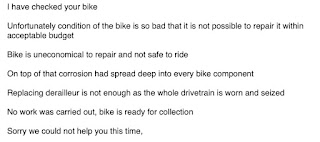
But recently I suffered a tragedy: the rear derailleur on my bike broke, and the bike shop said it was beyond economic repair.  In fact they went further and declared my bike dead on arrival, or as they put it, 'not possible to repair...not safe to ride... corrosion... deep into every bike component.

And as a way of mourning - and honouring - the passing of this bike, I thought I would reflect on how much it has helped me to learn, over the years: a bike I will fondly remember as my Learning Cycle.

Avid readers will remember how it helped me to become smarter than Sherlock Holmes, for example.  And how a fall from my bike helped me to recognise how I was developing my Inner Supervisor. 

You may also remember when I acquired the bike, a decade or so back, by dint of the excellent material on Negotiating Skills from Harvard (Getting to Yes) that I both teach and (on this as so many occasions) use myself.

But more profoundly, the bike has been part of my discipline, both of keeping fit and of learning, for many years now.  In this blog post, I reflect on that, including:

'Thus the discipline of getting out on my bike first thing every morning and cycling up the fells, come rain or shine, frees me in unexpected ways. At one level it is the obvious thing: being fitter makes me less prone to bugs, and being physically tired means I sleep well at night, free of insomnia. But it also frees me from rumination: I process a lot of thinking as I cycle.'


But, alas, my learning cycle is no more; but its legacy, in terms of the learning itself, will live on.

And I collect a new bike tomorrow (by which time I hope that they will have put the pedals on).

But what, asks Prodnose, has any of this to do with Kolb's Learning Cycle? to which I can only reply that such a question reflects a lack of abstract conceptualisation that shames him, before I hop on my bike and cycle off into the sunset...


Friday, 23 July 2021

The Temptation to Complacency

I had a supervision session booked with my excellent supervisor, Ann Bowen-Jones.  I use Ann specifically to supervise my work as a supervisor, and have other supervisory arrangements for my coaching. That is very deliberate, to make sure that my supervision is subject to regular oversight and reflection, and doesn't take second place, as it were, to my coaching in supervisory conversations.   So, as I say, I had a session booked; and as we talk regularly, and due to the way the diary fell, I had only conducted one supervision since our previous meeting. Moreover, that supervision had gone well: I had helped the coach I was working with to think more perceptively about the issue under discussion, to gain some insights, decide what to do, and generate some useful actions.  All in all, I was feeling pretty complacent about it.

But that raised the question of what to discuss at supervision with Ann. We could have looked more broadly at my supervision practice framework, but we have spent some time on that recently, and somehow that didn't feel the most productive thing to do. So I mentioned that I had only supervised once since we last spoke, that it had gone well, and that might be worth reviewing.

For my coaching clients, I rarely think that reviewing successes is a waste of time or self-indulgent (unless that is all that they want to do, ever...). But for myself, it felt different.

And yet this proved to be a very rich session indeed. And it wasn't because it is valuable to affirm strengths and build on them (though there was an element of that) but simply because there was so much more to think about than I had realised. Ann's skillful listening and questioning helped me to identify that there was something I was uneasy about, regarding my client's practice, and then to identify what that was and what I wanted to do about it. 

In turn, that led to consideration of my reflective practice after the session: why had I not identified that unease until now?

We also identified two or three other lines of enquiry, as it were, to explore with my client, none of which I had arrived at in my post-session review with myself. 

And I think that in least in part, that was a result of a certain complacency after the session. It had gone well; the client had made significant progress, and had been very appreciative of my supervision. And in that context, it was just too easy to engage in my private review of the session from a rather self-satisfied stance.   

I think I am not alone in this: that I learn well from my disasters; but my triumphs?... I should pay more heed to wisdom of Kipling, and treat those two imposters just the same.

Friday, 18 June 2021

Sandwiches and Firefighting


I have been reflecting on the importance of sandwiches this week. Not, as you may imagine, because the fine weather has been tempting me to go on many picnics; rather I am thinking of the sandwich structure of so much effective work.

It started in a supervision session, when I was talking about my coaching practice, and how important I find it to start and end coaching sessions well; with that in place, the middle works well, as does the whole process.  And then I reflected on a second-level sandwich: the importance of preparing well before a session, and reflecting and note-taking afterwards.  With that in place too, I know that I am doing a good job in each session. And of course there's a third sandwich to consider: the initial contracting at the start of the coaching relationship, and the close of the assignment, with consolidation, evaluation and so on. 

And it seems to me that many of my clients would also benefit from such sandwiches: planning before a meeting - and not just what they want to get out of it, but how (and indeed who) they want to be in the meeting. Likewise, after meetings, it is really valuable to reflect and review: did I accomplish what I wanted to; and did I do that in a way congruent with who I want to be? And if so, celebrate and record that, and build on it; and if not, what do I learn from that?

Yet for many of my clients, that feels like an impossible luxury: particularly in these days of Zoom, they zoom from meeting to meeting with little respite; and when asked, talk about the constant firefighting that they have to attend to.

Firefighting: an interesting and vivid metaphor; and not a subject I claim much expertise in. However, I am pretty sure that when firefighters turn up at a fire, they do a little planning before rushing in. One wouldn't want to pour water on an electrical fire; nor enter a structure about to collapse.  And likewise, once the flames are dowsed, I am pretty sure that they check that the temperature has been sufficiently lowered, to leave the site safely. We all know that all it takes is high temperature, fuel and oxygen (and possibly a source of ignition) to allow the fire to break out again.

So I find myself challenging some of my clients quite hard about this; and for some, that is helpful.  But what I know to be truly helpful is to hold myself to my sandwich disciplines: including, it occurs to me as I write this on a Friday afternoon, that other sandwich of ending the week with a review of how it has gone, and what I have learned, and using that to inform my planning of the following week.

--

With thanks to Eaters Collective and Daniel Tausis for sharing their photos on Unsplash


Friday, 14 May 2021

Coaching Evaluation

I attended a very interesting webinar on the evaluation of coaching by Louise Emerson, hosted by the Association for Coaching, this week. I find a lot of things are still buzzing around in my head as a result, so this post is a bit of a 'think-out-loud' as it were, about those.

One is the issue of solely relying on the coachee's perspective when evaluating the value and outcomes of a coaching relationship. Clearly, the coachee's perspective and feedback on his or her experience is very important: necessary but not sufficient.

Louise pointed out that a coachee is not wholly unbiased, nor necessarily the person with the most insight.  In terms of bias, the coachee may well have formed a positive relationship with the coach, which may well colour both what the coachee thinks, and what he or she wishes to say to the coach.  

In terms of insight, coachees are not experts on coaching: it is conceivable that coachees might rate as excellent (because helpful to them) a coaching process that was (from a professional point of view) flawed in various ways. 

At the simplest level, I have, more than once, had the experience of listening to people while they sort out a difficult issue, prompting them with occasional questions, and being awe-struck at the solutions they have created - and then been told 'Thank you!  I always find your advice so useful!'  Whilst I am happy to take the credit, advice is not perhaps the most accurate word; but the process is not important most coachees and they may not attend much to it: it is the outcomes they want.

And there's something else here. Sometimes when coachees have a particular insight, or a shift in attitude, it is easy for them to forget, after a while, that they ever saw the world differently. So whilst the new learning is valuable and embedded, the fact of its being new learning is forgotten. 

So that all suggests that other reference points are needed. One such point may be other people in the coachee's system: colleagues, boss etc.  In some instances that might be appropriate; but of course that needs contracting for (ideally at the start of the process). So that is making me think more about my contracting meetings, and discussing in more detail at that stage how we will evaluate the coaching, both as we go, at the end, and some time afterwards. I already do this, but I think I could do it with more rigour, and in particular, asking who else the coach thinks we could or should include in that evaluation. 

Another reference point is myself, of course. I do have quite a thorough process of reviewing and recording my reflections on my work after each session; so it is about ensuring that I continue to engage with that as an exploratory, learning conversation with myself, not allowing it to slide into a superficial from-filling exercise.

Related to that is supervision. Clearly, this is one of the purposes of my meeting with my various supervisors: to continue to evaluate the effectiveness of my professional practice. However, what I am adding to that agenda is reviewing my approach to evaluation itself, on a regular basis; as well as evaluating the effectiveness of individual sessions or coaching relationships.  That then leads to a rather expanded supervision agenda; for it is not only evaluation, but also things like contracting - and in fact my whole practice framework - that could usefully be reviewed explicitly and regularly.

Something else that occurred to me is that sometimes, at the end of a series of coaching sessions, I am (to be honest) a little disappointed at the coachee's summary of what he or she has learned. I sometimes think they are missing or forgetting learning that seemed really valuable or important. So there is a place for my offering that evaluation at that stage; both as a way of brining it back to the coachee's attention, which is valuable as a learning process; and also as a way of honouring and affirming the work the coachee has done.  Again, I think I could be more rigorous here, and I think that would spring from better note-taking, after each session, so that I can quickly review progress with specific examples to feed back to the coachee.

So, as I said, lots of thoughts to turn into action here: I will discuss these with my supervisor, as I find that one of the helpful ways of holding myself accountable and turning good intentions into action.


--


With thanks to Júnior Ferreira  Charles Deluvio  Aaron Burden for sharing their photos on Unsplash


Friday, 30 April 2021

Disclosure Remorse

Sometimes, when someone finally finds someone (say a coach) who is prepared to listen to them... and then listen some more... and then listen some more... without interrupting, without sharing parallels from their own experience, without judging, and without offering advice... well, sometimes they pour out their heart and their soul.  That can be particularly true if there are things that they have been unable to talk about or process in any other forum: so the confidentiality of a coaching relationship makes that particularly likely.

I have experienced that, as a coach, on many occasions, and very frequently in the initial, introductory conversation. Once someone has established that it is safe to talk - that confidentiality is guaranteed, and (I assume) having judged that I can be trusted - it can be a huge relief finally to tell someone just what they are thinking and feeling. At times they cry, or shout. And that is all OK.

And then a curious thing sometimes happens.  At the next meeting, they turn up much more guarded, or sometimes even noticeably uncomfortable. That is what I term Disclosure Remorse.

Interestingly, I don't remember reading anything in any of the coaching literature about this; nor has it been discussed on any of the coaching courses, workshops or masterclasses that I have attended.

I began to wonder if it was just me...

And then I discussed it with one of my supervisors. He comes from a therapeutic background, and recognised what I was describing instantly. Indeed, he also told me that he often discusses this with his clients at an early stage, and invites them to think ahead: 'what will you think, do you imagine, when you look back on this conversation, and think how open and honest you have been - how vulnerable you have allowed yourself to be?'  He reassures them that this is both normal, and valuable in the context of the conversations that they will continue to have together.

That was hugely helpful (and exemplifies one of the many benefits of supervision). So now I have a strategy to address this.

And of course, Disclosure Remorse is completely understandable.  We all have boundaries in place, and often for good reason; and when we cross those boundaries (as, I realise, I reflected towards the end of this post when I had done so) we feel vulnerable, and possibly even some sense of shame. Sometimes that may be wholly appropriate, of course; without wishing to over-indulge in self-disclosure, I can recall times as a student, say, and involving alcohol, when I was quite right to be ashamed the next morning of things I may have said...  But clearly in the context of coaching (and even more, therapy) such shame is misplaced.

So I am pleased that my supervisor helped me to develop an appropriate strategy - and I look forward to trying it out, and seeing if it is, in fact, as helpful as I expect.

--

With thanks to Tom Pumford  Kyle Glenn and  Christian Erfurt for sharing their photography on Unsplash


Friday, 16 April 2021

Your Brain at Work


A few weeks ago I blogged about David Rock's SCARF model. At that time, as I said, I hadn't read his book, Your Brain at Work, which introduces the model.  I am now reading it; and whilst I have not yet finished it, I can highly recommend it. In the first place, that's because my friend and colleague, Deiric McCann at Genos recommends it, and he is nobody's fool.  But also I have now read enough of it to vouch for it myself. It is well-researched, very readable, well-written and very practical.

The subtitle of the book gives some good clues about its scope: Strategies for overcoming distraction, regaining focus, and working smarter all day long. And of course, the title gives another big clue.

What Rock has done, is pull together a coherent understanding of a broad range of research into the brain, and create a user's guide. 

He presents it as a series of fictional case studies: a day in the life of Emily and Paul, broken into short scenes that illustrate the problems they encounter in a fairly typical, stressy, day at work. After each scene, he reviews the relevant research and how it might apply to the situation that Paul or Emily has just messed up, and then offers an alternative scene, based on Paul or Emily applying the research intelligently to manage how they use their brain to inform their behaviour, interactions with others, and so forth.  Each chapter concludes with a summary of the key points (Surprises About the Brain) and some suggestions of Things to Try.

For example at the end of Chapter One, which is about Overload, the Surprises about the Brain are:

  • Conscious thinking involves deeply complex biological interactions in the brain among billions of neurons 
  • Every time the brain works on an idea consciously, it uses up measurable and limited resource 
  • Some mental processes take up a lot more energy than others 
  • The most important mental processes such as prioritising often take the most effort 
and Some Things to Try are:
  • Think of conscious thinking as a precious resource to conserve
  • Prioritise prioritising, as it's an energy-intensive activity
  • Save mental energy for prioritising by avoiding other high-energy-consuming conscious activities, such as dealing with emails
  • Schedule the most attention-rich tasks when you have a fresh and alert mind
  • Use the brain to interact with information, rather than store information, by creating visuals for complex ideas and by listing projects
  • Schedule blocks of time for different modes of thinking.
And so it goes on: pulling together, in simple, useable, understandable and accessible form a wealth of knowledge and practical applications. Much of this is not new if you have read around the subject; but some is. And having it all presented in such a well-explained and user-friendly way is very valuable. 

The book is divided into four Acts (each of several Scenes, or chapters) as follows: 

Act 1: Problems and Decisions
Act 2: Stay Cool Under Pressure
Act 3: Collaborate with others
Act 4: Facilitate Change

Whilst the Emily and Paul plot can feel a little contrived, it is nonetheless an engaging and most importantly clear and memorable way of illustrating the points that Rock is making.

All in all, this is an excellent and practical introduction to the key domains of Emotional Intelligence: self awareness, self management, awareness of others, and relationship management. 


It's probably helpful to add a link to the website, that has some excellent blog posts, too.


Friday, 16 October 2020

Emotional Intelligence - a Behavioural Approach


At the start of lockdown, I declared a sabbatical, and embarked on a number of CPD projects. In addition to those I planned at that stage, and in part because of a recommendation by David Clutterbuck, with whom I was studying Leadership Team Coaching, I signed up for a programme with Genos, to become proficient in, and qualified to use, their range of Emotional Intelligence assessments, feedback reports, and development programmes. I have just completed that, and (subject to a practical next week - update: undertaken and passed..) will soon have  (update: now have) the badge. There were a few things I particularly liked about the Genos approach. One was the chap leading the programme, Deiric McCann who was credible and entertaining.  

A second was their model of EI:


This is more comprehensive than many, having six core competences, each underpinned by seven specific behaviours. And that is the other thing I really like: the assessments are behavioural. They ask those giving feedback on an individual about specific observable behaviours. Not only that, but they ask both how important each behaviour is, and also how frequently they see it demonstrated. That gives participants very specific feedback. On the one hand, they learn what they are doing that works, that people find valuable; and on the other, what they could do more of, in order to increase the quality of their interactions with others. And that is all backed up with benchmarking data, and of course with written comments by those completing the feedback.

So I am looking forward to working with this assessment - which is available both in a leadership and a workplace version (ie for those without leadership responsibilities).  I certainly found it useful when I went through the process myself, and got some very helpful and specific pointers both about my strengths and a few things to try differently or more frequently.

For example, one of the behaviours in the Positive Influence competence is 'Responds effectively to others' inappropriate behaviour.' My colleagues who completed the feedback rated this as highly important, but rated my level of demonstrated behaviour rather lower (still high, and within the benchmark, I should add, not that I'm feeling at all sensitive or defensive, you understand...).  That is really helpful to know, and prompted some real reflection.  And I realise that there is some truth in it: I do tend to be a bit laissez-faire, and to see where something is going, rather than intervene early and clearly when someone does or says something inappropriate. And the feedback from my colleagues is that they would prefer it if I intervened; so I will be seeking opportunities to do so. (You have been warned!).  But I hope that makes it clear why I like this particular approach compared to some of the other assessments out there: it gives such specific behavioural feedback, that it is easy to develop a plan of action (putting the plan into action may be more difficult, but that's another story...)

The remaining question, of course, is whether behaving in a more emotionally intelligent way actually increases one's emotional intelligence. It seems clear that it will certainly increase one's demonstrated Emotional Intelligence, and that is surely what the development process is supposed to achieve.  But further, the process of engaging in this way will also lead to greater self awareness, which is one of the foundations of EI, and also self management (which is another EI competence).  Beyond that I refer you to Aristotle on Virtues: we acquire them by practicing them. 


Thursday, 1 October 2020

Getting into my stride...

I have posted previously about my initial reservations about, and slow conversion to, online development workshops.

This week I delivered the final workshop in a Negotiating Skills programme I have developed, that required participants to work through six short online modules, before attending. And it worked! They had done the modules and learned the model. So they came to the workshop with intelligent questions about it and ready to engage in practicing the thinking and skills that they had been studying.  It wasn't free of glitches, of course, but we have learned a lot that will make the next iteration better.  

The online modules were offered in three formats - videos, podcasts and written documents; and there was a reflective learning log for participants to record their learning in after each module.  We'll be following up with a proper evaluative survey after a few weeks, when they have had the chance to apply their learning in the workplace (or forget it) and I will be fascinated to read their feedback.

In the meantime, you can count me as a full convert. And with a convert's evangelical zeal, I thought it might be helpful to share a few of the things I am learning about making online sessions effective - and in particular some of the tools I am finding helpful.

Clearly, the key thing is to be really clear about content, and deliver that in helpful, accessible and engaging ways.  And in terms of engaging, there are some neat things you can do. Zoom breakout rooms (other brands are available, here and throughout this post) are invaluable; and there's a couple of things I've learned about using them. 

One is the need to be really clear about what people are required to do in the break out and how they can go about it (my instructions normally start with 'share the time fairly...').  I give people the brief verbally, and also put a link in the chatbox to an online word doc with the brief in writing.  I have also taken to assigning people to go to the rooms automatically, rather than waiting for them to click on the 'take me to the room' option - it just speeds things up and simplifies them. I also broadcast time checks to them in the rooms at the half way point, and when time is nearly up. And I don't go into the rooms to check up on them - I have found that interrupts their work whereas I prefer to give them the responsibility to use the time wisely; and in my experience, they do.

Other tools I have found helpful include Jamboard which is a virtual online whiteboard.  You can pre-prepare these for subgroups in the breakout rooms, and put the links in the chatbox; or for plenary sharing of ideas after a breakout; for action planning, as well as idea generation etc.  Participants can add virtual post-it notes (or pictures, draw etc) simultaneously, and you (and they) can keep the link to have a record of their work afterwards.


I also like the look of Slido, which I have yet to use as a facilitator (I have been on the receiving end, as it were...).  Slido allows polling, quizzes, question sorting, wordcloud generation etc. You can also pre-prepare things like team action planning sheets in Excel, (saved online) and include names, dates, accountabilities etc, and put the link in the chat, to get the team to complete the sheet in live time - and of course have a usable record of the action plan.

The final thing I want to comment on, is the value of investing in a decent microphone and camera. For what it's worth (and based, as is most of this learning, on colleagues' sharing their experience and recommendations,) I have a Rode NT microphone (which we cheerfully refer to as the rodent, for obvious reasons) and a Razer Kiyo camera. These mean that I can be confident that I can be seen and heard clearly - a huge improvement on the built-in mike and camera in my laptop.

As ever, I'm interested in others' experiences, ideas and recommendations, so do let me know what is working well for you in this virtual world.

Friday, 4 September 2020

Leadership in Lockdown

I have been very interested to hear how leaders have been reacting to the COVID crisis and the strains it has placed on their organisations.  Two leaders, in particular, have interesting stories: one the CEO of a small charity, the other a leader of a significant health and education organisation.

The charity CEO did a few things that struck me as very impressive. Like many charities, their funding was extremely curtailed as many of their normal fundraising opportunities were closed down. The CEO's strategy was to take a dramatic paycut himself, to gather the team and ask them to consider what drop in pay they (individually) could afford to take for a while and then commit to that, to focus as many of the team as possible of grant-seeking/application activities; and (and this was particularly interesting) to reduce staffing by having all senior staff work two weeks on and two weeks off, in an overlapping pattern.  That resulted in a balanced approach that contrasted strongly with other organisations I know, where some staff were worked to exhaustion and beyond, whilst others were stuck at home unable to do anything - and both groups resenting the other... Then, they landed a large grant, and all were immediately reinstated to their previous pay levels, and the team's commitment and mutual solidarity is considerably enhanced.


The other leader expanded his leadership team, to include more and younger members, in the face of an overwhelming increase in demands for decisions and complexity of issues to consider. He delegated more than he has ever done before - he is the first to admit that he likes a hands-on leadership approach, and to know  what is going on; but that proved impossible. Team members really stepped up, and some of the younger ones in particular far exceeded his expectations. The wider community's trust in the leadership team was enhanced by their competent handling of the crisis, and the leader has now convened a team workshop to examine how and why they were so successful during the crisis, and how to take that learning forward. One of the lessons he knows that he has to apply is to maintain his new-found ability to delegate much more significantly, even though that is against his personal habits and preferences.

All of which raises the interesting question: how do we ensure that the lessons learned during this crisis are learned and shared widely, so that we get what good we can from it?

--

Thanks to Dylan Gillis and Nick Fewings for sharing their work on Unsplash.

Wednesday, 12 August 2020

How to be Smarter Than Sherlock Holmes

In The Adventure of the Priory School, Sherlock Holmes famously makes a false deduction: 

“This track, as you perceive, was made by a rider who was going from the direction of the school.” “Or towards it?” “No, no, my dear Watson. The more deeply sunk impression is, of course, the hind wheel, upon which the weight rests. You perceive several places where it has passed across and obliterated the more shallow mark of the front one. It was undoubtedly heading away from the school.” 

That, of course, does not work. Whichever direction the bike was travelling in, the rear wheel will over-ride the marks left by the front wheel.

However, with that unique combination of genius and superficiality (I had nearly said, frivolity) that is, perhaps, the hallmark of my thinking, I realised, this morning as I cycled over the fells, how Conan Doyle could have made this clue work.

For I observed that bicycle tracks leading up to an obstacle or a hazard give very definite clues about the direction of travel. That is because the obstacle or hazard appears differently, depending on the direction from which one is approaching it, and therefore the cyclist will steer a different path accordingly. For example, I saw a cycle track that went into a puddle over a steep lip, and emerged on a gentle gradient on the other side. That makes perfect sense if the cyclist had approached from one direction, from which the steep lip was invisible, but was implausible from the other direction - indeed riding a bike up that lip would have been not only an odd course to pick, but also almost impossible.  From the other direction, the lip would have been very obvious, as would a slight deviation to the right that would have avoided it.

Why blog about this? There are, of course several reasons (my late father always maintained that there were always two reasons for any course of action: the good reason and the real reason...). The real reasons, in this case are my inherent superficiality (or even frivolity, see above) and the fact that I have to blog about something (I have set myself a target), so whatever comes to mind is grist to that particular mill.

The good reason is that this is an elegant metaphor for understanding other people. When someone approaches an obstacle or hazard, the course they steer can tell us a lot about their approach.  For example, I am rather gung-ho with a low level of risk aversion. I am unlikely to notice many hazards, until I am almost on top of them. I may well be the archetype envisioned by whoever created the aphorism 'Fools rush in...' And my point is that someone observing me, who did not know me, could quickly learn that about me, simply by watching my headlong rush towards a potentially risky situation.

Whereas a wiser person might start planning for contingencies a bit earlier; and a highly risk-averse person might avoid embarking on the journey altogether. 

The way in which we typically perceive hazards or obstacles can be revealing, too. As we enter a recession, some people are concerned about the macro-economic picture, others are concerned about the organisations that may go under, others about are excited about the political opportunity this gives them, whilst others are lamenting the job losses and the plight of young people entering a shrinking job market. Each of these is a perfectly understandable reaction (though not all equally laudable, of course). But each reaction also tells us something about how someone is seeing the situation, and may well shed light on what their biases and values are.

Which reminds me of something I learned many years ago, on a writing workshop run by Bob McKee (which also featured a fascinating scene-by-scene analysis of Casablanca, but that's another story).  Bob said: True character is revealed in the choices a human being makes under pressure - the greater the pressure, the deeper the revelation, the truer the choice to the character's essential nature.

So if you want to be smarter than Sherlock Holmes, avoid deducing anything from clues that don't work; but do pay attention to how the cyclist approaches a hazard: it may tell you a lot about his or her direction of travel.


With thanks to Felix Hanspach, Patrick Hendry and Tim Collins for sharing their photography via Unsplash.

Saturday, 25 July 2020

From grumpy to enthusiastic...

It's always entertaining when we ourselves go through precisely the journey we discuss with our clients, with regard to change.

There are, of course, many such journeys; but not an infinite number. So one can discuss probable pathways for different people, and this is certainly one typical one...

At the start of lockdown, I was fairly clear in my own head that the one-to-one work I do could easily continue online.  Indeed, I have been doing telephone coaching for many years, and zoom/skype (other brands are available) coaching for quite a few.

But the group facilitation, and in particular skills training, was not really possible in that way. Indeed, I was clear that some of the key skills I see myself bringing to that process, such as the creation of a safe but rigorously challenging atmosphere, rely on physical presence; likewise, some of the benefits of the workshops I run, such as building connections and networks (and to some extent, I stand by that).

So it was with (well-disguised, I hope) ill grace that I agreed to run some online sessions for one of my clients; to continue at least to some extent, a programme that had started pre-lockdown, and to honour, as best we could, the commitment of the participants.

The first sessions were largely idea- and feeling-sharing; and were very well received.  And due to participants' enthusiasm, and because some of the topics we had on the agenda for later meetings were about behavioural skills, such as influencing, I decided to see what we could do in terms of skills practice in that environment.

My prejudice against doing this kind of work online was reinforced by some of the online CPD I was doing, which was presented in dull and unimaginative ways, and included little skills practice of any value.

However, that set me thinking about what I would do differently, to make online learning more engaging, and to what extent practice in the virtual environment is, in fact, possible.

So I have been experimenting with giving more information (about theories or models) in advance, of an online workshop, and with getting people to participate in small groups without me there to supervise or hold their hand - and that has gone really well.

So I am now, enthusiastically, working up a full negotiating skills programme, which will consist of: several short modules of learning, which can be either read as short handouts with some reflective questions at the end, watched as a series of short videos (and again with reference to the reflective questions at the end of each module), or listened to, as a podcast in short chapters (and ditto re questions). That will be followed by some demonstration negotiations: one that goes well, one that is tough but gets to a resolution, and one where there is no final agreement due to one party's intransigence - all with some commentary. 

Alongside that, we will have an a-synchronous online discussion, in which participants can discuss various questions posed by me, and also anything else arising from their study, reflection or experience. Finally, there will be a live online workshop, where participants can  ask questions about the work done so far, and then practice the skills in small groups with other participants.

I am fortunate enough to have a client who is equally excited about this approach, and we are looking to go live in September. If it works well, I will be making it available to other clients, and also developing a number of other workshops on the same basis.

So I have done a complete u-turn on this. I can see several benefits to this approach (as well as some disadvantages). People can engage at times that work for them, which can be as short as a few minutes, or more extended if they want. They can re-visit any parts they want to, or go back after the demo negotiations to deepen their theoretical understanding after seeing the process in practice, and so on.  It won't be the same as a live workshop, and it won't draw on the same skills from me; but it does rely on other skills I have acquired over the years, and perhaps take for granted.

And the meta-lesson is that this is so often how people progress through change - and one of the elements that most change models under-emphasise, in my view, is the effect of time. People need time to assimilate the new reality, to re-orientate themselves, and to make new understandings of their role and contribution. We need to be careful not to reinforce their initial grumpiness in our haste to make progress, or we can sabotage that natural process.

--


With thanks to Brooke CagleChristine Donaldson and Fabian Qunitero for sharing their photography via Unsplash.

Sunday, 5 July 2020

Still learning (after all these years...)

Someone recently quoted the (possibly apocryphal) answer that Pablo Casals gave, in his eighties, to the question: 'Why do you still practise for 6 or more hours a day, when you are the greatest cellist of the twentieth century?' He (is alleged to have) replied: "I think I am beginning to get the hang of it..."

Having written that, I am hesitant to continue with the post I had planned: I may be a good coach, but I am not the Casals of the coaching world.  Nonetheless, the anecdote does speak to the point I wished to write about, so I will swallow my misgivings and proceed.

On the practicum session for the Leadership Team programme I am currently studying, we were in small groups and had to role play a scenario in which we were coaching the leader of a team in a difficult situation that had filled her with despair. 

I did a good job, I thought, in helping her both to articulate her current situation, but also to think of the future, identify where she and the team needed to get to, and (most importantly) re-discover a sense of hope. That then enabled her to come back to the present, and work out the first actions she could take that would share her hope with the team, get clarity and support she needed from her boss and so on.  We only had 20 minutes or so for the role play, and I felt that we had done a lot in that time. The others in the small group agreed; but as we reviewed the session, I realised that I had missed the point.

The brief for the exercise had been to help the team leader to start to co-create a team development plan for the whole team - and to discuss how to engage the team in that co-creation. The idea is to gain common understanding and agreement about the current situation and challenges, and also to agree the way the team want to work on addressing it through their own development journey.  That is the necessary foundation for a truly engaged approach that will weather the inevitable difficulties that such a learning journey will encounter.

And I had known that - yet I colluded with the team leader in a rush to action, with insufficient diagnosis, and with no thought given either to the whole journey, or to engaging the rest of the leadership in the diagnosis and planning.

This made me reflect, once more, on the conscious competence model of learning. That is, I had learned, in my head (from the teaching and examples presented by Peter Hawkins and David Clutterbuck on the programme) about the importance of that stage of the process; yet in practice, my habitual approach had taken over: I had played to my strengths; and that had gone well, except that I was doing the wrong thing. And what the conscious competence model does so well is not merely illustrate the problem, but also point to the solution: and that is practice. In order to turn the intellectual understanding I have acquired on the course into a reliable skill, I need to try it out, over and over again, until I get good at it.

And I am trying not to be too annoyed at myself for having to learn that lesson (again) through experience... but I suppose that if Pablo Cassals still felt the need for practise at the age of eighty-something, then I am in good company.