Showing posts with label Thinking Environment. Show all posts

Thursday, 23 July 2026

Reflections on our Thinking Environment Day of Practice and Discovery


The Delegates
Last week we had our long-heralded Day of Practice and Discovery at Durham University. We brought together 40 people who are interested in the use of Nancy Kline's Thinking Environment in the context of HE or FE. It was a remarkable day for several reasons.

The first was that we heard from a range of people in different HE and FE settings who have been experimenting with the use of the Thinking Environment; from those using it as a modus operandi in PhD supervision (which is pretty radical, when you think about it!) to those who have found that it enables and supports cultural change at the organisational level. For details of all the sessions, see here.

The second was that every session included extensive opportunities for all present to think together about whatever the presenters had shared. We used a range of Thinking Environment approaches to do this, including rounds, thinking pairs, dialogue, and a Thinking Council.

The Team

The third was that the whole day had been put together using Thinking Environment principles from the start. The organising team met and thought together about what needed to be done and organised themselves to do it. 

The fourth was that all delegates were offered opportunities, both one-to-one and group, to experience the Thinking Environment in practice, prior to the conference, to ensure they had a rich understanding of the ideas underpinning the day.

And the fifth was that the whole day was done on a shoe-string budget, so that we could offer it for £50 a head - just enough to cover the hire of the venue and the food. We (almost) broke even.

The result was a day that was buzzing from start to finish, with high levels of engagement, and loads of fresh thinking arising in every session. We are collating some of the outputs now and they will appear in due course on the TE in HE website.  And we all had a lot of fun, too.

Thursday, 19 March 2026

Thinking Environment Day of Practice and Discovery

I am pleased to announce that theWebsite for the Thinking Environment in Higher Education Day of Practice and Discovery, is now live. 

We are limiting the numbers to 50, to ensure maximum opportunities for participation in the practice, so book early to avoid disappointment!


For details of the day, the different sessions, and of course the venue and price, see the website. www.teinhe.co.uk


If you have any questions, don't hesitate to ask me, or any of the names on the website that you recognise.


There's no early bird discount, for two reasons. One is that we have made the price as affordable as we can: it just covers the room hire, food and incidental expenses (such as this website). The second is that one of the components of a Thinking Environment is Equality, and we would not like to have people paying different prices for the same event. 


We look forward to welcoming you to this day of practice and discovery!


Monday, 19 January 2026

Thinking Partnership Programme in the Lake District

If your role involves helping, stimulating, supporting, challenging or provoking others to think at their very best, you may be familiar with Nancy Kline's work, published as Time to Think, More Time to Think, and The Promise that Changes Everything. If you are not, these books are well worth reading and learning from. 

At the heart of Nancy's approach, which she calls a Thinking Environment, is the belief that attention is generative; that is, the quality of someone's thinking, in my presence, is at least in part a product of the quality of attention that I give to them. (If you doubt this, consider the reverse: when you are trying to think about something and the person who is meant to be listening is clearly not attending... see what I mean?) 

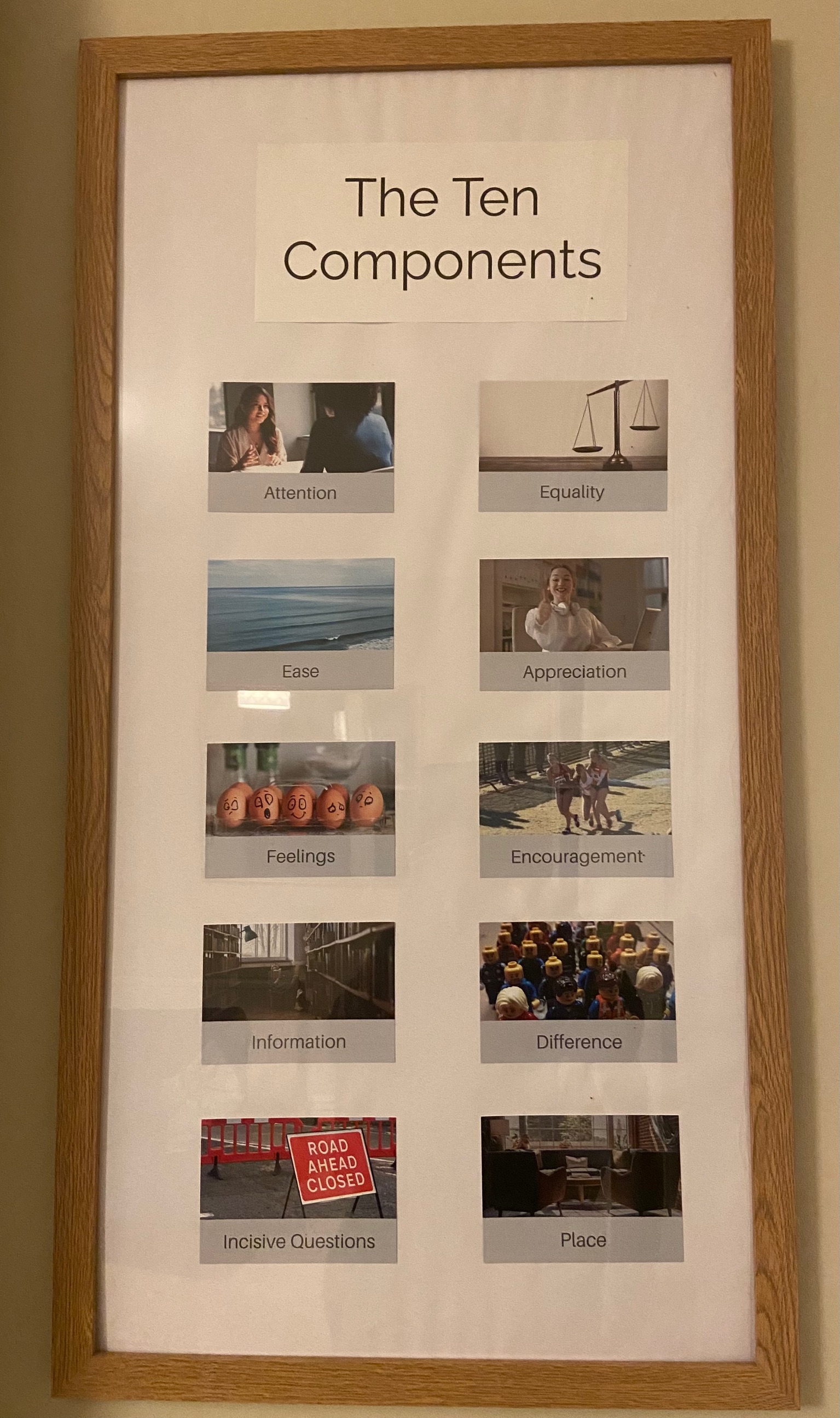
But in addition to a quality of attention that is in fact rare in most work contexts, there are nine other components; these work together as a system to produce that Thinking Environment which enables great thinking. Further, there are several applications: ways of using these components and this system, in different contexts (one-to-one, groups etc).

Foundational is the Thinking Partnership: a precise but easeful approach to enabling someone else to think outstandingly well. I have blogged previously about this many times, ranging from my initial exploration of the process with Nancy, through to its practical application in a coaching session. (Other posts may be found by clicking this link to an index of my posts about the Thinking Environment). 

The next Thinking Partnership Programme is on 12/13 March and 15 May. This will run at our home and office in the Lake District: a wonderful setting.

Previous participants have commented on the quality of the experience as being something like a retreat - and many have come back a second and third time for that reason (and to deepen their understanding of the work - and indeed to enjoy Jane's catering...).

This Programme teaches you the Thinking Partnership Session®, a uniquely powerful process for liberating the human mind. Through generative Attention and the building of Incisive Questions, this process produces breakthrough, independent thinking.

If you choose to join us, you will participate both as Thinker (considering topics of your choice), and as Thinking Partner (practicing this elegant expertise). Along the way you will explore all Ten Components of a Thinking Environment. This course is a prerequisite for the Coach Qualifying Course, should you wish to take your practice to the next level.

More details are on my website, here; and of course if you wish to talk about the programme, or have any questions, I'd be delighted to hear from you.

Wednesday, 10 September 2025

Freshest thinking...

This morning I started my latest CPD: a 6-month programme on Psychology for Coaches, run by Marie Stopforth for the Curious Coaching Company.

One of the points Marie made in this introductory session was the importance of holding theories lightly, engaging with them with curiosity, and always as a means to an end - the client's increased self-awareness. As an example, she mentioned Self Determination Theory (SDT), and how an understanding of the three components of motivation that it suggests (perceived autonomy, perceived competence, and perceived relatedness) might inform the questions one explored with a client who declared he or she felt unmotivated; but also that one should not be so wedded to the theory that one believes one knows what is going on for the client.

And of course that makes sense; it might be a useful framework in that context, and holding it lightly is a good approach. 

But what also occurred to me, as we reflected in small groups, was that SDT might additionally offer an insight into the effectiveness of Kline's Thinking Environment - an approach I favour.

Famously, this involves a much less directed approach to questioning (so the questions would not be informed by SDT). However, I think the Thinking Environment process is designed to strengthen all three of these areas.

In terms of perceived autonomy, the Thinking Partner's (ie Coach's) belief that the Thinker can address their own issues without any input or directive questions from the Thinking Partner maximises the Thinker's autonomy. The same is true of perceived competence: the Thinking Partner champions the Thinker's ability to resolve their own issues, believing in it even when the Thinker may start to doubt it. And the experience of being listened to with the quality of attention that the Thinking Environment is famed for, along with the other components of Appreciation, and Encouragement, tends to result in the Thinker feeling valued, which speaks to the heart of the Relatedness aspect. 

And that's one of the reasons I am doing this programme; to help me to think afresh about what I do and why it works, as well as what might be the limitations of my approaches, and what else I might do.

--

(Image from Wikipedia: Creative Commons Licence)

Tuesday, 6 May 2025

What we can articulate...

I am continuing to listen to the excellent podcasts by Bishop Erik Varden that I have mentioned previously, on the Desert Fathers (and Mothers, in case you were wondering). And once more, it was a piece of his wisdom that was almost an aside that caught my attention the other day. 

He was talking about the importance of precision in language, and how words that the Fathers had used with a very particular meaning, such as compunction, have been watered down and sanitised, so that modern dictionary definitions are both anodyne and misleading if one wants to know what the Fathers were talking about. And this matters, he explained, because 'what we can articulate, we can learn to deal with. 

It seems to me that there is a lot of wisdom in that comment. And it is not new wisdom of course (the Fathers were in the early centuries of the Church); and it is evident in folk and popular culture: the idea of a nameless dread is particularly potent; as is the Thingy in the moat (in the Ahlberg's wonderful 'It was a dark and stormy night'); and this is precisely why Dumbledore encourages Harry to use Voldemort's name, rather than the euphemism (He who must not be named) that only increases his power.

It also helps me to articulate part of what I help my clients to do, that they find valuable. For example, in my Shifting Stories work, I get them to articulate and name the unhelpful stories that are holding them back. and also the more helpful stories that are available to them. This articulation and naming gives them more agency and helps them to choose the more helpful over the unhelpful in times of need.  

Likewise, the Thinking Environment work is precisely about giving people the time and attention to articulate their thinking in much more depth and breadth than they are normally allowed to do before they are interrupted (by someone else, life, or themselves...); and again, they find that very valuable.

It is not a panacea. Bishop Varden does not say, What we can articulate, we can deal with, but rather, we can learn to deal with. Which also explains something about the value of Gestalt approaches, which again focus on increasing the individual's awareness - including somatic and emotional awareness - of current reality as a necessary, and often sufficient, approach to change and growth. Heightened awareness enables us to articulate, whether through reason or metaphor, image or intuition, what really is; and then - I hope - we can learn to deal with it.


Friday, 2 May 2025

A Refreshing Approach to Conference Workshops

Every now and then, I get invited to do sessions at conferences (not keynotes - I am not a thought-leader, apparently - but breakout workshops). I always find this an entertaining process, from the initial request from the organisers to have my slide deck well in advance - and their bafflement when I tell them I won't be using slides - to the look of shock on participants'

faces when they turn up for my session to find that they will be sitting in a circle without a table to hide behind.

And then I get asked back; probably because the organisers get feedback like this: 

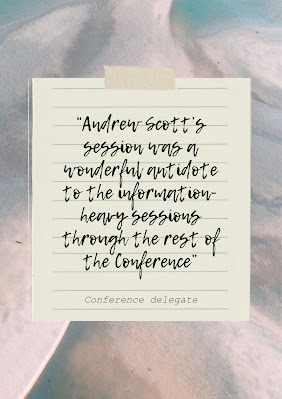
“Andrew Scott's session was a wonderful antidote to the information-heavy sessions through the rest of the conference. It slowed folks down and created space for deep, meaningful conversations. I'd suggest handing over some time in the programme for all delegates to have that 'Time to Think' together, deeply and meaningfully.”

So what do I do that is so different? The short answer is that I run my workshops as Thinking Environments (qv).

The longer answer follows, in case you are interested (if not, leave now: I won't be offended - my ego-needs are met in other ways - which might also be a clue about why people like my sessions...)

I always start with welcoming the participants, appreciating them for choosing to come to my workshop, and reminding them of the purpose of the session (which is always along the lines of 'to give you the time and opportunity to think with colleagues, about...')

We then do an opening round (at least one, sometimes more) so that everyone has the opportunity to be heard early in the session, and also to practice listening with complete attention, to everyone else in the room. I give the briefest of explanations about the why and the how of this, and we dive in. It always lands well, and signals that this is going to be different...

I then give them a brief overview, framework or perspective on whatever the session is about (the most recent one I did was on William Bridges' model of change and transition, which is excellent). My intention here is to give them something valuable that they will easily be able to recall, and also enough stimulation to have an engaged conversation with other participants about the topic.

Then I explain a little about how we will work throughout the session. This is a lightning introduction to the Thinking Environment and some of the key components: Attention, Equality, Ease and Appreciation. I try to get through all of that in less than 50% of the time available for my session; the rest is dedicated to their thinking together in small groups (using rounds and then open discussion, but always with exquisite attention and a complete ban on interrupting!). We conclude with a couple of rounds: one on their freshest thinking about the topic, and the final one on what they have appreciated about working together in this session.

And the feedback at that stage is often very similar to the comment quoted above. I was particularly amused recently when someone said how great it had been to have no input from the speaker, but rather the chance to think for themselves.  They certainly had that (and I was gratified that it was appreciated) but I had also given them a 15' mini-input on Bridges' model to seed that conversation. But what I was hearing, of course, was the impact of the session being run in such an unorthodox way. 


If you are interested in learning more about working with groups in ways that inspire great thinking together, I still have a couple of places left on my Thinking Environment Foundation Programme, here in the Lake District (19/20 June).  We've a really interesting group of people booked on so far, from a range of different organisational contexts - and we've room for just a couple more.  Full details are here

Tuesday, 25 February 2025

Learn How to Facilitate Groups Brilliantly: the Thinking Environment Foundation Programme

Do you run team meetings, facilitate learning events, chair boards or executive groups, or in any other context,  get people together to think about important things?  Do you ever find that people don't contribute as well as you would hope, or that some dominate and others don't contribute?

If you wish to take your skills in running groups to the next level, and develop a set of approaches that increases participation, honest discussion and real engagement, then you will find it valuable to engage with the Thiniking Environment.

This is based on Nancy Kline's work, published as Time to Think, More Time to Think, and The Promise that Changes Everything.

At the heart of Nancy's approach, which she calls a Thinking Environment, is the belief that attention is generative; that is, the quality of someone's thinking, in my presence, is at least in part a product of the quality of attention that I give to them. (if you doubt this, consider the reverse: when you are trying to think about something and the person who is meant to be listening is clearly not attending... see what I mean?)

But in addition to a quality of attention that is in fact rare in most work contexts, there are nine other components of Thinking Environment; and there are various applications of these components that are suited to both group and one-to-one contexts.

The Foundation Programme is an introduction to this work in the context of working with groups: a precise but easeful approach to enabling all present to think outstandingly well.  I have blogged previously about this many times, ranging from my initial exploration of the process with Nancy, through to its practical application in a coaching session. (Other posts may be found by clicking here).

So I am delighted once more to be offering the Foundation Programme in the Lake District, this June (19/20). This Programme teaches you the ten components of the Thinking Environment, and a number of practical applications and findings that will transform your meetings.

If you choose to join us, you will be working as part of a small group of practitioners, jointly exploring the practice through practice!  Here's what a previous participant ha dot say about one of my programmes:

I really enjoyed the practice based approach you used throughout. Your role in the group was perfectly pitched - it felt like we were a group of equal thinkers, but you had more insight into the approach, which you shared generously with us. I really appreciated you sharing your experiences of using the approach in different contexts and also current knowledge of changes and  discussions with Nancy. This felt as if we were up to date with the latest thinking. 

This course is a prerequisite for the Thinking Environment Facilitator Qualifying Course, should you wish to take your practice to the next level.

More details are on my website, here; and of course if you wish to talk about the programme, or have any questions, I'd be delighted to hear from you.

Monday, 25 November 2024

If you knew...

Jane and I do a Spelling Bee most days. Towards the end of the day, we often compare notes, and to spur each other on to greater success, we might ask How many words have you got starting with the letter N? And whoever has the fewer, knows that there are more to be had - and (and this is the point of this otherwise mundane domestic scene) often quickly finds a few more. 

It reminds me of an exercise I used to do many years ago, when I ran workshops on creativity for tech companies. Instead of asking 'How might we {very difficult challenge}?" I'd get them to frame the challenge as: 'Our competitors have just {very difficult challenge} - how do you think they have done it?' And again, it seemed that the knowledge that a solution is out there makes it easier (or makes us more determined?) to find one.

In both cases, it's almost as if asking the question (implied in both my examples) 'If you knew that ... how would you...?' prompts the brain to do some exceptional work.

And that, of course, is precisely the structure of an Incisive Question, in a Thinking Environment. 

Coincidence? I think not...

Therefore, if you need to clear a blockage, in your own or someone else's thinking, it's a great structure to use. As an Incisive Question, its formal job is to remove an untrue assumption and replace it with a true one.  I think that is also what happens implicitly in the other examples I cite. It removes the assumption that there are no more words beginning with N, or that there is no solution to this difficult challenge, and replaces them with an assumption of possibility, that enables the brain to break through.

So if you knew that this was a powerful structure, how would you use it?

Friday, 11 October 2024

Interruption 9/10

One of the joys of teaching without notes is that I sometimes surprises myself by what I say.  

It happened yesterday evening, when I was running a CPD session for the ICF Wales and Shropshire Coaches Group: an Introduction to the Thinking Environment. (For one participant's insightful reflections, see here).

I had given a brief overview of Attention, Equality and Ease, as the first three of the ten components that I wanted them to practice, and heard myself say: 'And interruptions, of course, violate all three of these.'   I had never stated it quite that way before, but recognised that it was absolutely accurate.

Which led me to think further (and this is, in part why I love a Thinking Environment) after the session.  Is there any of the components that Interruptions do not violate?

Clearly they assault appreciation, encouragement, and the full expression of feelings.  But the others are less obvious and deserve unpacking.

I think interruptions also undermine the component of Difference; for often they take the form of agreement (yes, that happened to me!) which minimises difference in the search for comfortable commonality) or disagreement (no, what I think is...) which often fails to honour difference, but rather 'correct' the other.

Place is interesting: and my thinking here is that interruptions do attack place, as they shift the focus, or even locus (which means place) of attention from the thinker to the interrupter.

The component of Incisive question is perhaps less obviously attacked; but one way we understand generative listening is that it implicitly (and silently) asks the incisive question: if you knew that I believe you have more good thinking to do on this, what would you say? In that context, it is clear that interruptions violate that.

And that's the 9/10 of my title.  Which leaves the component of Information. And frequently that is the content of the interruption: something the interrupter knows (or thinks) that he or she feels an urgent need to share with the thinker. But even in that instance, an interruption also impedes information: what would the thinker have said next if not interrupted.  So perhaps it's nine and a half out of ten that interruptions sabotage. But that would have been a less snappy title!

What do you think?

Wednesday, 12 June 2024

Thinking Partnership Programme

So this Thinking Environment… It springs from the work of Nancy Kline and is founded on a profound belief in the capacity of the human mind to think outstandingly well - given the right conditions.

This seems to me to be a core skill for a coach: to enable the person we are working with to think independently at his or her very best. Thinking independently is thinking as ourselves and for ourselves.

Kline's thesis is that we do this primarily by paying the person being coached a level of attention that is rare in daily life; and that such attention is generative of good thinking. The idea is, the quality of the individual’s thinking,  is (at least in part) a product of the quality of attention that we give them.

In Time to Think, and its successor, More Time to Think, Kline describes ten components of a Thinking Environment. 

The first, and the most important, of the components is attention. Attention of the quality we mean here is simple, but difficult - and rare. It consists of giving your whole attention to the person that you are listening to.

That means, amongst other things:
  • removing all distractions (eg electronic devices with alerts…),
  • refraining from taking notes whilst the individual is thinking,
  • keeping a 'soft gaze' (of interest and encouragement) on the person’s face (though the person thinking may, of course, look wherever he or she chooses), 
  • not thinking about how you will respond or what wise question you will ask next, 
  • and above all, not interrupting.
In fact, even when someone stops talking, we refrain from interrupting the silence, as he or she may still be thinking. Thinking comes in waves, and the freshest thinking often arises after a pause. Such attention is so rare that it may feel like a luxury, or even feel uncomfortable; but it does seem to support really good thinking. 

The other nine components are equally rich, but I will not describe them all here, as it would make this a very long post. 

Coaching in this way is very different from many approaches. It takes seriously the assumption that the individual is more likely to come up with good solutions than the coach; the coach's role is to provide the environment - the Thinking Environment - in which that is most likely to happen.  I have blogged before about a specific example of this.

If you want to explore this further, I have a few places left on my next Thinking Partnership Programme (5/6 Sept and 11 Oct) here in the glorious Lake District.  Don't hesitate to get in touch if you want to know more, or have a look at my website, here.

Disclosure Remorse (again)


I have blogged previously about disclosure remorse, and  I mentioned my supervisor's excellent advice about discussing this explicitly with the client, in a pre-emptive way.

It came up again in conversation with a colleague the other day, and as we are both Thinking Environment practitioners, we were naturally considering it in the light of the ten components.

Which raised the interesting question of Equality. One of the reasons, we suspect, for disclosure remorse may well be inequality. The client may have shared so much with the coach, and yet the coach has disclosed nothing in return - which may leave the client feeling vulnerable.

That might imply that it is appropriate, in terms of establishing the relationship on a basis of equality, for us to share some vulnerability in our turn (always being mindful, perhaps, of the other cautionary advice, about scars, not wounds...)

So, how do we share a bit of vulnerability with the client at that stage, without making the conversation about us, rather than the client? 

That was the question that we arrived at, and then time ran out.  If we, (or indeed I alone) find an answer to it, I'l certainly blog about that, too.  And if you know an answer, please tell me.

Friday, 17 May 2024

A Sounding Board?

One of the things that people (particularly people in senior roles) often say, when reflecting on their experience of coaching, is that they have valued me as a sounding board.

I find that interesting, as I don't often pass judgement on what they are thinking. When they ask what I think, my first reaction is normally to treat that as a courtesy: they think they've been going on too long, and it's my turn to speak.  So I reassure them that I am still interested in what they think and encourage them to continue thinking. They nearly always do (and it is nearly always fruitful).

However, occasionally someone persists and asks for my view. Even then I don't act as a sounding board, according to the dictionary definition: a person or group whose reactions to suggested ideas are used as a test of their validity or likely success before they are made public. I am more likely to share some further way of thinking about the issue at hand: some theoretical model, or questions it raises in my mind, or some such. 


And reflecting on this, it made me wonder what a sounding board actually is.  Insofar as I had given it any thought, I was conflating it with the soundboard of a piano: which amplifies the resonance of the strings.

Which is not far wrong, but a sounding board (as opposed to a sound board) is apparently 'a structure placed above and sometimes also behind a pulpit or other speaking platform that helps to project the sound of the speaker. It is usually made of wood.'

Passing swiftly over the fact that this excuses me from seeming somewhat wooden at times (though I hope that I am never sounding bored...), this gave me pause for thought. I am not sure that the metaphor quite works; and I am sure that the other meaning, concerning testing the validity of ideas, is the one the people have in mind when they use the term.


But there is something there, I think, and perhaps it is to do with the notions of projection and resonance. I have blogged before about why it is particularly helpful to think out loud in someone else's presence, rather than merely on one's own (valuable though that is). 

And pondering the sounding board metaphor makes me want to add to that: there is something about thinking out loud that helps us to project our thinking into the world in a way that enables us to check how well it resonates with us. That is, when we hear ourselves say it out loud, it sounds different and clearer, and that allows us to evaluate how well it is attuned to what we really think, believe, and value.  

So perhaps it is not I who am the sounding board, but rather the thinker.  I am merely the reason (I nearly wrote excuse) for their saying out loud what otherwise might go round and round in their head.

I would be interested to know if this resonates with you...

--

Piano Diagram from Blackham, 1965 (apparently) via  Antoine Chaigne on ResearchGate; Sounding Board photo from The Accidental Atheist blog though where he got it from, I don't know...

Monday, 29 April 2024

Doing and Being

Reflecting on my post last week, about 
Listening, Difference and Psychological Safety, I think that - whilst I stand by every word of if - it may be a bit misleading.  It reads as though, if one does all the things I mention, that will necessarily create psychological safety.  And I do not believe that to be the case. 

In fact, if one approaches the activity with that attitude, I think it probably won't work.One of the things that Nancy Kline is fond of saying to teachers of the Thinking Environment is 'What you are teaching is you!' 

That is to say, the Thinking Environment is about the Environment we create for others when they are thinking in our presence. So whilst understanding and striving to create the 10 Components is essential, even more essential is trying to be and live the 10 Components: to embody them in the way we are, and the way we relate to people.

That is one of the reasons that a condition of accreditation in this work is a commitment to have regular Thinking Partnership sessions with another skilled practitioner.  It is also the reason that one of the key aspects of training in this work is what I call 'total immersion.' That is why I choose not to run training online. The feedback I get from participants on my programmes in the Lake District is that they have a quality something like a retreat.  And that, I think, is something about being, not just doing.

Friday, 19 April 2024

Listening, Difference and Psychological Safety

This week I ran a session at the AHUA (Association of Heads of University Administration) conference in Leeds.  It was called Listening, Difference and Psychological Safety and was about facilitating conversations about topics where the discourse has become so toxic on campus that it seems people are determined not to listen to those with other views (the trans/GC issue, and the conflict in the Middle East are two current examples). 

I started, very deliberately, with a few processes and activities designed to generate and strengthen a sense of psychological safety in the room, including a series of Rounds at the small tables around which participants were gathered (See here for some reflections on why Rounds are so effective at creating Psychological Safety).

I then pointed out what I had done and why: how my introduction, use of rounds (and the questions I'd chosen to ask them) and use of humour were all designed to calm the amygdala, and invite them to engage their pro-social (rather than fight-or-flight) operating systems (if this is new to you, see here).

That led us onto why I was running the session: the problem I was seeking to address (and one which they all recognised: they had, after all, chosen to attend this session rather than the others on offer at the same time).  I shared some experiences of being told by academics and professional staff in universities of topics that were not safe to discuss, and my unease at that, and my belief that Nancy Kline's work had something to offer here.

Then I described the experiment we had run at the Thinking Environment Collegiate. of getting people with strongly-held opposing views to have a dialogue, with the brief to understand the other and seek to be understood (but not to persuade or seek to persuade). This had the effect of changing neither party's beliefs, but (and this was the interesting and valuable bit) each person felt more positively about the other after the discussion than before - not the usual result of such exchanges.  (I have written about this more extensively here).

We then discussed the components of a Thinking Environment in a little more detail, and in particular the dialogue process. In this, two people agree on the question to be addressed. Then Person 1 asks Person 2 the question, and listens, with complete attention, and above all without interrupting, while Person 2 thinks out loud about the question. Person 2 has the discipline only to talk for 2 or 3 minutes, and then ask Person 1: What do you think?  Person 2 then listens, with complete attention, and above all without interrupting, while Person 1 thinks out loud about the question (which may or may not include picking up themes from Person 2's thoughts). Person 1 has the discipline only to talk for 2 or 3 minutes, and then ask Person 2: What do you think?  and so on. 

This process is extraordinary.  Each person, knowing that he or she will not be interrupted, is free to think, without urgency, and knowing that he or she will have a further turn also releases pressure. Paying heed to the other, by not talking  too long, and by inviting the other to think in turn, also transforms the conversation; and above all, genuinely listening to the other, seeking to understand, changes the whole emotional dynamic. 

So having described that, I got them to do it. And they found the results as powerful as I had promised.

Finally I got them to appreciate the person with whom they had had the dialogue, and share a key learning in a final round in plenary.

The feedback was very powerful: not least as people felt they had some practical techniques they could go away and implement with a high level of confidence.

And many committed to coming to the AHUA Diversity of Viewpoints Workshop which I will be running in London in September, to explore these ideas, and this approach, in more depth.

Tuesday, 16 April 2024

The Foundation Programme; Facilitating Groups Brilliantly

Do you run team meetings, facilitate learning events, chair boards or executive groups, or in any other context,  get people together to think about important things?  Do you ever find that people don't contribute as well as you would hope, or that some dominate and others don't contribute?

If you wish to take your skills in running groups to the next level, and develop a set of approaches that increases participation, honest discussion and real engagement, then you will find it valuable to engage with the Thiniking Environment.

This is based on Nancy Kline's work, published as Time to Think, More Time to Think, and The Promise that Changes Everything.

At the heart of Nancy's approach, which she calls a Thinking Environment, is the belief that attention is generative; that is, the quality of someone's thinking, in my presence, is at least in part a product of the quality of attention that I give to them. (if you doubt this, consider the reverse: when you are trying to think about something and the person who is meant to be listening is clearly not attending... see what I mean?)

But in addition to a quality of attention that is in fact rare in most work contexts, there are nine other components of Thinking Environment; and there are various applications of these components that are suited to both group and one-to-one contexts.

The Foundation Programme is an introduction to this work in the context of working with groups: a precise but easeful approach to enabling all present to think outstandingly well.  I have blogged previously about this many times, ranging from my initial exploration of the process with Nancy, through to its practical application in a coaching session. (Other posts may be found by clicking here).

So I am delighted to be offering the Foundation Programme in the Lake District, this June (13/14). This Programme teaches you the ten components of the Thinking Environment, and a number of practical applications and findings that will transform your meetings.

If you choose to join us, you will be working as part of a small group of practitioners, jointly exploring the practice through practice!

This course is a prerequisite for the Thinking Environment Facilitator Qualifying Course, should you wish to take your practice to the next level.

More details are on my website, here; and of course if you wish to talk about the programme, or have any questions, I'd be delighted to hear from you.