Showing posts with label Autism. Show all posts

Sunday, 3 March 2024

A challenging tension

I have been reflecting on an interesting tension, which I can see no obvious way to resolve. So, as I often do in such situations, I thought I'd write about it, both to clarify my own thoughts and in the hope that others might be interested and might have insights to share. 

So here's the thing. One of the issues that the current enthusiasm for Diversity and Inclusion as values is addressing, is the phenomenon known as 'othering.' (I know, my linguistic sensitivities don't like it either, but it seems to be the vogue term). This is the process of identifying someone or some group as outsiders, often accompanied by negative stereotyping,  For a full (and fairly typical) account, see here. Clearly, this can be problematic, whether in an organisational context, when it will impede working relationships and therefore organisational effectiveness, and also at a societal level, when it can lay the foundations for prejudicial discrimination, and in extremis, de-humanisation and persecution. 
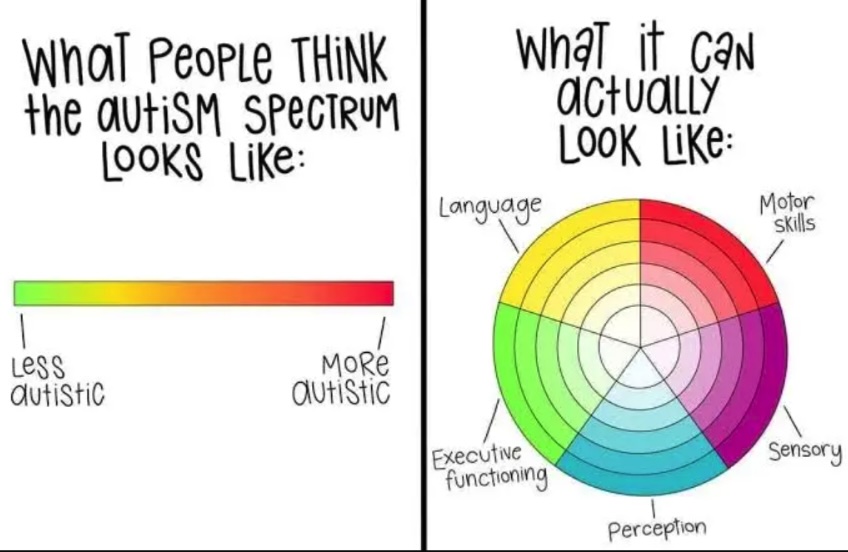
One of the responses to this is to lay great stress on our common humanity, and to expand the bandwidth of what we perceive as normal, so that we do not see people who are different from us as abnormal, or 'other.' A fairly common example is when people say, with regard to Autism Spectrum Disorders, ' Of course, we're all on the spectrum somewhere.' Yet this well-intentioned attempt to normalise ASD can meet a very angry response. Some people with ASD, and those who advocate for them, point out that this approach has several unhelpful, unintended consequences.

One is that it risks minimising the very real difficulties some people face. For example, I am not particularly socially skilled, particularly in unstructured situations. But to attribute that to my being 'a bit on the spectrum' seems to belittle the very significant difficulties some of the people I know with autism encounter in such contexts. They (and I) would argue it is a difference in kind, not just of degree.

A second and related risk is that it may obscure the need for reasonable adjustments at work and in broader society to enable the full and fair participation.

So that's the tension: how do we sufficiently normalise difference that we reduce the risk of othering, whilst maintaining sufficient and useful distinctions, so as to ensure that differing needs are fully understood and met?

--

Images: Tug-of-war generated by 123RF; Autism Spectrum seen repeatedly on Linked In, but I haven't found an attribution or originator: happy to credit if anyone tells me!


Friday, 7 October 2016

A World Without Down's?

I was very moved by Sally Phillips' documentary on Down's Syndrome and pre-natal screening this week: A World Without Down's. 

In the first instance, I was shocked by my own prejudice. I like to think of myself (who doesn't?) as without prejudice, but I noticed a small but discernible visceral reaction to the physical appearance of Olly, Sally's son, who has Down's. 

I was quickly won over, of course, by his infectious personality; and it made me reflect that I know nobody with Down's, and that my life is the poorer as a result. I know some people - including family members - with varying degrees of autism, and am aware how that has resulted in my being fully comfortable with such people.  But, as I say, I was shocked by my own visceral prejudice, based purely on unfamiliarity.

I was also profoundly moved by the interview with the young mother who had terminated her pregnancy at 25 weeks on learning that her baby (probably) had Down's. Her description of the moment when she could feel her baby moving within her, then it was injected in its heart, and then it stopped moving was terribly upsetting - not least for her.

To me, it seemed to cut through some of the easy rhetoric about 'My body, my choice.' For it was clearly not only her body that was at issue here: the heart that was injected and stopped was not her heart. Perhaps that was compounded by the fact that my daughter is currently expecting a baby.

But this notion of autonomous choice is very dear to us as a society. Sarah Ditum's review of the programme in the New Statesman exemplifies this. To say that Sally Phillips' programme was 'anti-choice' is enough to damn it, in Ditum's view.

However I want to think a little more about this notion of choice.  On the one hand, it seems very atomised. Each individual mother making a choice to terminate a Down's baby has a cumulative effect that reaches beyond them: that was the thrust of Phillips' concerns, though she herself was careful not to actually contradict the choice mantra, in the programme.  But the programme raised the question: who do we think is worthy to live in our society?  And it is not just about people with Down's but also autism (as pre-natal screening for autism is also nearly with us).

I think that the world would be a poorer place if we eliminate all those who are markedly different, or different in ways that 'we' find uncomfortable to deal with. Yet that is the foreseeable consequence of the sum of the individual choices that mothers are likely to make (as Iceland demonstrates). And there are other consequences too: as one mother put it on Twitter: 'We try so hard for inclusion/acceptance & NIPT makes it harder. That our kids are only here b/c tests failed?'

There is another aspect of choice that I think worthy of reflection, too. We talk of 'informed' choice; but as Sally made clear, no amount of information can tell you the reality of having a child with Down's; and still less how you will in fact respond to that reality. So the choice is inevitably made on the basis of assumptions, and as we heard very clearly in the programme, fears and prejudices.

Further, thinking of Kubler-Ross' research, and the transition curve, we are compelling women to make that choice at a particular moment, when they are going through the emotionally charged experience of learning that their child has Down's. But we know that the way she will react will change over time - but the nature of the choice demands a quick decision. Such a decision may well not be the one she would make given more time and more support.

That is why we do not offer people who are attempting suicide the choice of a quick and easy way to do so: we recognise that the choice to commit suicide is very often one that is made at a particular moment, and that with help and support the individual will be glad not to have been able to act on that choice. For, as with abortion, it is an irreversible one.

So am I anti-choice?  Well, I am anti- some choices. As we all are. We don't say of (say) bullying behaviour that 'it may be wrong for you, but you can't judge other people.'  We recognise that bullying behaviour is wrong, not just for me, but for everyone. The degree of subjective responsibility may of course be mitigated by particular circumstances, but the behaviour is still wrong and harmful.

Further, I believe that choices made from fear and based on partial knowledge and prejudice are likely to be less positive and life-affirming than choices that spring from love and courage.

So, of course, we cannot and should not pass judgment on the woman who shared her story of terminating her pregnancy at 25 weeks.  But I believe that objectively, that was a wrong thing to do - and a wrong choice for her to be offered.

This is a complex and fraught area: but I am grateful for Sally Phillips' powerful and thought-provoking programme for making me reflect more on it.

And I, for one, don't want to see a World Without Down's.