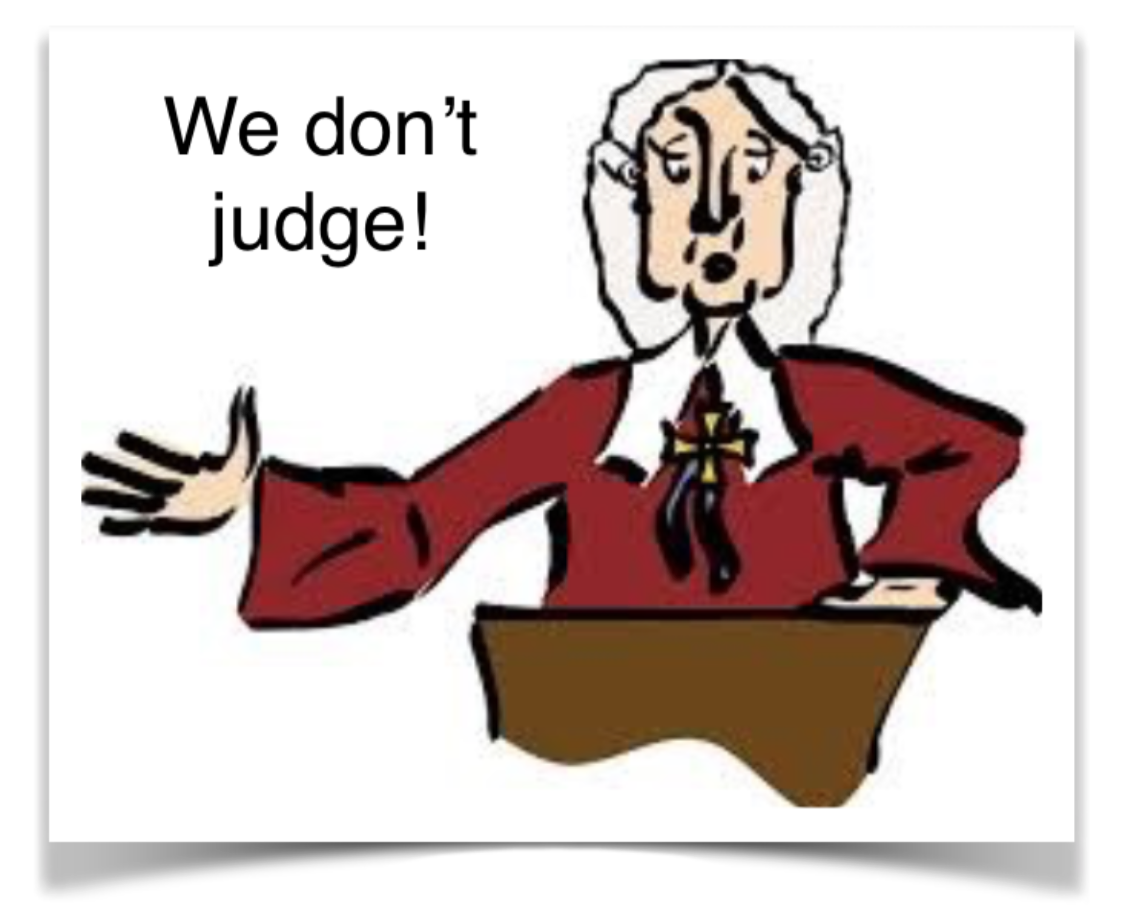
Showing posts with label non-judgemental approach. Show all posts

Friday, 17 October 2025

The Rush to Judgement

In this week's episode of Desert Fathers in a Year (ab
out which I have written before), +Erik Varden reads the story of Isaac the Theban, who had judged a fellow monk. On returning to his cell, he found his way blocked by an angel, who rebuked him for judging, which is God's prerogative. Isaac of course repented. And the main point of the story is that we shouldn't judge others, and that when we fall, we should repent. 

But Bishop Varden, with his characteristic passing comment that adds so much, and reflects the depth of his own wisdom, adds: 'a penchant for judging in this way may remain with us even when we have made some progress in the spiritual life, when our eyes are open to behold God's angels.'

Which brought me up short. Why are my eyes not open to behold God's angels? Or to put it another way why is it that I could happily return to my cell having judged someone else, and thought no more about it. Why is my conscience so dulled? (For surely, conscience is another way that God's voice might speak to us in such a situation).

And I think the answer is that I am not sufficiently recollected, or living with ease (in Nancy Kline's terminology). Kline sees ease as a freedom from urgency (internal and external) and from interruptions (likewise, both internal and external). We keep ourselves so busy that we don't notice when we have casually passed judgement on someone. And knowing what we do about the Fundamental Attribution Error (that tendency to overemphasise a person's personality or character as the cause for their behaviour, while underestimating situational or environmental factors) our judgment is likely to be erroneous and unjust anyway.

+Varden goes on to say that my rush to judgment may well be an act of self-defense by means of attack, and cites another story, told by Dorotheus of Gaza in the 6th century, about three people who see a man standing on a street corner at night.  Each reaches a different conclusion about him: the first thinks he is about to do something lecherous; the second that he is a robber, and the third, that he is waiting for a friend to go and pray together. 

Projection, as we call it now, was clearly recognised back then.

So rather than rush to judgement, I need to slow down, and recognise what such an impulse to judge, and what the judgments I am inclined to make, tell me about myself. 

Or to put it another way, to slow down until I see the Angels.

Thursday, 13 February 2025

The Devil You Know


I am continuing to think about issues and themes raised by Gwen Adshead's excellent book, The Devil You Know, about which I have blogged previously. One of the fascinating tensions that comes through from her autobiographical reflections on her work with people who have done evil, concerns judgement and being non-judgemental (another topic I have blogged about before).

On the one hand, it is clear that listening in a non-judgemental way is extremely valuable and important in helping people to tell their stories.  And that, in turn, is very important in terms of their learning, growth and healing as human beings. 

And yet, it is also important that they reach a judgement on their evil actions (for in the context of the cases Adshead considers, that is what we are dealing with - murder, child sexual abuse etc). It seems clear that when they can name their offence rather than use a euphemism (such as 'my index') and acknowledge the evil of it, they are on the path to recovery. So the judgement is important, and a practitioner's non-judgemental listening should not collude with any denial of that. 

Carl Rogers is interesting here: as a therapist he was renowned for his non-judgemental listening and his unconditional positive regard. Yet in raising his children - and in his own private life - he held to high moral standards. Yet the non-judgemental approach, and his stance of unconditional positive regard eventually caused him profound problems, probably contributing to his breakdown later in his life; in particular when he found that for some of the therapists he was training, being 'authentic' included sleeping with clients; and they would say 'it may be wrong for you Carl, but it's not for me...' - and from his position of being non-judgemental and striving to maintain unconditional positive regard, he found he had nowhere to stand to correct them (he also confided to Bill Coulson that he was no longer competent to edit the journals he was editor of, as he was so attuned to the effort and positive intentions of those who wrote papers that he was not able to evaluate which ones were of real value, and still less able to tell some authors that theirs weren't). 

So my (somewhat tentative) conclusion is that being non-judgemental is a useful listening stance (in some situations) but we need not to allow it to become our moral stance. It is stark in Adshead's world of high security psychiatric hospitals, where the evils are so clear, but is equally important in the world of work and our domestic lives, when perhaps it is more tempting to collude in the name of kindness, or to keep the peace.

Friday, 16 October 2015

Non-Judgemental Coaching

I have been reflecting on Non-Judgemental Coaching, and this post is really my thinking aloud on the topic.

On the face of it, being non-judgemental seems a good stance for a coach to take, and it is often taken as a given for good coaching practice. See here, and here for a couple of fairly typical examples. 

But the more I think of this, the less that simple stance makes sense.

On the one hand, of course nobody wants to be judged, and further, as a coach, one tries to work with the client's material, including his or her judgement.

However, even in the first article cited above, the author writes:   It is, however, a truism that it is necessary and useful to challenge universal truths the Client holds if these are limiting or otherwise damaging to the process of self-change and realisation. Building the coaching relationship is a dynamic process which nurtures honesty, trust, reliability and curiosity.

Clearly, such challenges are based on a judgement, made by the coach, that 'these are limiting or otherwise damaging to the process of self-change and realisation.' So how can one call such an approach non-judgemental?

Likewise, to say that 'Building the coaching relationship is a dynamic process which nurtures honesty, trust, reliability and curiosity,' is to bring a lot of judgements to bear: not least, judgements about the desirability of 'honesty, trust, reliability and curiosity.'

Moreover, one of the things a coach may decide is important is to offer support to a client who is making a difficult decision, which others are deriding. It may well be the client's own decision; and indeed that may well be why, as a coach, one would want to support it, to help develop the client to develop his or her autonomy. But such support is in itself a judgement - approving the client's courage in making a difficult autonomous decision is judgemental.

Sometimes when I go down this track with people, they retreat into saying that being judgemental is making negative judgements, not positive ones. But even that won't do. If I approve some decisions, then the client knows that I am making a judgement. If I am then silent about other decisions, the client will understand that I am withholding approval - which is also a judgement.

Moreover, posing as non-judgemental, if that is not what we are actually thinking or feeling, is inauthentic; and therefore likely to be counter-productive in terms of the coaching relationship.

So I think that we need to be much more nuanced than this, and my current working theory is this:

1 I do not judge my clients, as people;
2 I am likely to reach judgements about their decisions, or actions; it may or may not be helpful to let them know these;
3 The client's own judgements about their decisions or actions are more important to elicit and to work with;
4 The client's judgements are not infallible;
5 It is part of my professional responsibility to make many other judgements: about the way in which we are working together; about what interventions might be appropriate; about ethical considerations; and more besides. 

But as I say, this is thinking aloud, so I am interested in others' views on this - and will doubtless develop, and possibly change, mine.

--

PS  (2021) I wrote this some 6 years ago now, and of all my blog posts, it is the one that is most visited on a regular basis - it now has nearly double the number of hits compared to any other post. I am curious about this: if you read this, and feel so inclined, could you add a comment to let me know what or who directed you here. Has someone somewhere put it on a reading list - and if so, as an example of wisdom, idiocy, or something in-between?...  Thanks  AS