Back in December I made a brief video reminder for people who had attended my Time Management workshops. I blogged about it here, including some ideas for how to do it better next time. Well, next time has come around; in fact we now have two more in the can, as I believe the term is. I only wish that I had read my ideas for how to do it better before making them. Nonetheless, I remembered most of the things I wanted to do differently, and so, without further ado, here is the first of them, a short (under five minute) video, summarising the workshop I run on Emotionally Intelligent Leadership. I will be interested, as ever, in any feedback.
I was hoping to upload the video directly from my laptop; and further hoped that might mean that it would be viewable on mobile phones and tablets as well as laptops and PCs. But Blogger decreed the file too big, so I had to do it via Youtube as before. Here is the link.
I have blogged about humour before, (here, for example). I think it serves many important purposes, including making things memorable, reducing stress, provoking fresh perspectives, and making life more joyful. However there are risks attached. One person's joke may be offensive to someone else. I am in a reflective mood, having just read some feedback about a session I ran in a university. Someone was put off by a joke I had made which he or she found entirely inappropriate. I understand that it provoked a strong response that it took some time to get over, and that was clearly no part of my intention. I am also keenly aware that if one person gives such feedback, it may well be that others are thinking it. Or they may not be - it is very hard to know. Humour is risky. The joke under consideration was in the context of talking about time management and Viktor Frankl's work, derived from his experience in a concentration camp. I summarised that he found that the people who survived the camps with their humanity intact were those who had a meaning or purpose in their life, beyond mere brute survival. I added 'and my hope is that if a sense of purpose makes it possible to hang onto your humanity even in a concentration camp, then maybe it's possible in a University,' or words to that effect. My intention, of course, was not to belittle the unspeakable evils of the Nazi camps; rather to use humour's capacity for provoking a sharp change of perspective, to help people reflect that however disempowered and frustrated they may feel at work in a University, at times, they have vastly more power and freedom than Frankl had; and along with that, the idea that holding onto a clear sense of purpose is valuable when we do feel disempowered and frustrated. But clearly, that was not the message received, by at least one person. I am very sorry for that, and particularly as it detracted from that individual's (and possibly others') learning from, and enjoyment of, the session. But I am also reluctant to withdraw from taking the risk of making jokes. Maybe that joke was ill-judged (and I'll be interested in others' views on that) but I think that most jokes carry a risk. Yet I would not want to eliminate them all together, as a humourless workplace seems a high price to pay. I need to think further about this - both the particular joke and the broader principle... In the meantime, here is Viktor Frankl. I am glad to see he uses humour, though possibly with better taste than I do.
Much of the work I do is predicated on the importance of people learning from and with their peers. Action Learning and Open Space events, for example, are expressly designed to enable that. Both research and practice suggest that for many people, particularly in senior or complex roles, learning from peers is a very important part of their continuing development. For me, that is what networking is for (and not the rather uncomfortable marketing/speed dating approach fostered by some professional networking event organisers). So I was delighted to join the Cumbria Coaching Network, having discovered it at their Change Fest event in October. I have blogged about a couple of their events before: the workshop on laughter, which was part of the Change Fest and one on Brain-Powered Goal Setting. Today's meeting was an opportunity both to be coached by someone else, and also to offer another member coaching and receive feedback on that. Even before the formal start of the session, I benefited from sharing a lift with Andy Hilton, who runs Result CIC - a social enterprise which offers training and coaching to marginalised groups, particularly those disadvantaged by disability. Andy and I had met at a previous CCN event, and had subsequently met for a coffee and conversation, leading to interesting learning and opportunities for both of us. The meeting today started with a group discussion, which allowed me to get to know a few more people, before we broke into pairs for the coaching practical sessions
I was lucky enough to work with John Wright of Symbiosis and Lake District Adventures. With skilled listening and appropriate questions and challenge, John helped me to clarify and commit to some important goals for the coming year. He also gave me some positive and helpful feedback on my brief coaching session when I reciprocated. This exposure to another coach's style and approach is very valuable as I seek to improve my skills and understanding as a coach. One of the interesting points for both of us was that we each wanted to hear the others' views and advice: we did not want pure non-directive coaching. Yet we are both well aware of the difference between coaching and advising. I guess the key is that we were both clear about what we wanted from our coach in the session, and each of us (as coaches) checked that, and honoured it. And the lunch, at the Strickland Arms, was very good, too. All in all, a great end to the week!
So, after a fortnight off, for Christmas and the New Year, things have kicked off with a pretty busy week. I had a proposal to write on Monday, and since then have been coaching in Newcastle, running a workshop in Durham, facilitating a programme in Cardiff, meeting old friends (with a new baby) in Shrewsbury, meeting a new contact in Lancaster, sharing experience with a coaching colleague in Cumbria, and talking with my coaching supervisor from the comfort of my own home. And now I stop to draw breath (before heading off to Winchester on Monday...) All of which makes me pause and reflect on the importance of planning; and not just planning for all the activity, but also for some inactivity. I have blogged before (here) about the importance of stopping and making time for meditation, and since that post have been pretty successful in doing so on a daily basis.
And I have to report that the benefits are very clear to me. I think more clearly, engage with tasks in a more focused way, and maintain a healthy sense of perspective. And the busier I get, the more important it seems to be (as well as more difficult). But apparently, Mother Teresa used to say that she would always make an hour for prayer at the start of every day, unless she was really busy. When she was really busy, she raised it to two hours! I get the point, but have to admit I just give it fifteen minutes: and that really does repay itself.
I wish all my clients, colleagues and friends a very blessed Christmas and a happy and successful New Year. 2014 has been a very good year for us;
I have had lots of interesting work with interesting people, ranging from academics to sailing instructors;
I have made significant progress on the long-promised book, and it is nearly finished;
Annie married and started work, Clare graduated and has exciting travel planned in the New Year, Mike finished school, changed direction and is studying Graphic Design very successfully, and Lizzie continues to excel at school and sports.
I always think Christmas a good time for poetry, so here is a contribution to the festive spirit: Christmas The bells of waiting Advent ring, The Tortoise stove is lit again And lamp-oil light across the night Has caught the streaks of winter rain In many a stained-glass window sheen From Crimson Lake to Hookers Green.
The holly in the windy hedge And round the Manor House the yew Will soon be stripped to deck the ledge, The altar, font and arch and pew, So that the villagers can say 'The church looks nice' on Christmas Day.
Provincial Public Houses blaze, Corporation tramcars clang, On lighted tenements I gaze, Where paper decorations hang, And bunting in the red Town Hall Says 'Merry Christmas to you all'.
And London shops on Christmas Eve Are strung with silver bells and flowers As hurrying clerks the City leave To pigeon-haunted classic towers, And marbled clouds go scudding by The many-steepled London sky.
And girls in slacks remember Dad, And oafish louts remember Mum, And sleepless children's hearts are glad. And Christmas-morning bells say 'Come!' Even to shining ones who dwell Safe in the Dorchester Hotel.
And is it true, This most tremendous tale of all, Seen in a stained-glass window's hue, A Baby in an ox's stall ? The Maker of the stars and sea Become a Child on earth for me ?
And is it true ? For if it is, No loving fingers tying strings Around those tissued fripperies, The sweet and silly Christmas things, Bath salts and inexpensive scent And hideous tie so kindly meant,
No love that in a family dwells, No carolling in frosty air, Nor all the steeple-shaking bells Can with this single Truth compare - That God was man in Palestine And lives today in Bread and Wine.
I was invited to a coaching supervision group today, with a view to joining it. I already have a coaching supervisor, of course, but this is something rather different: an opportunity to work with other very experienced coaches to share experiences, practice and learning. The process we used today was very rich. One member presented a coaching problem she was currently experiencing. Another coached her about it, while the rest of us watched. We then discussed, with a metaphorical glass screen in place, her issue and her approach to it, talking about her in the third person, while she listened and took notes. We then discussed the coaching process we had observed, and what we thought had worked well, as well as what we might have done differently. A very simple process, but because of the skills, knowledge and insights of all involved, a very rich one. I will certainly be going again...
A week or so back I made a video (see here), as a reminder for people who have attended my Time Management Workshop of some of the key points. My intention is to do this reasonably frequently, so that eventually people who attend any of my regular workshops will have some brief reminders of key points.
In the interests of full disclosure, I should mention that the urgency that made this one actually happen was a requirement in a tender I was completing at the time. However, I do hope that it is a useful addition to my portfolio of support for clients, and intend, as I say, to continue to make them, as and when time and inspiration permit.
In the meantime, I thought that it would be helpful for me, and possibly of interest to some of my readers, to reflect on the process of making it, and the lessons learned.
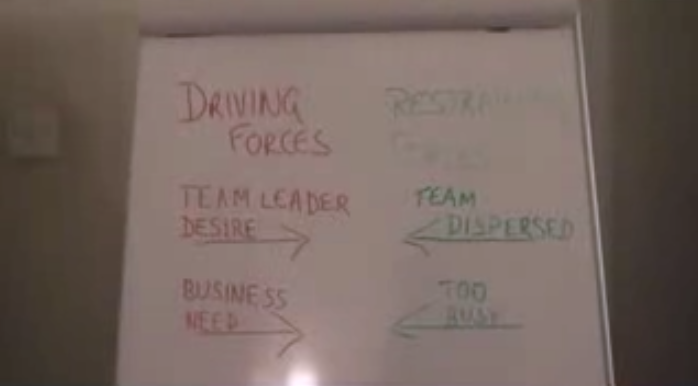
The first thing to say is that this is not my first attempt. Some time ago, I made one about Force Field Analysis. From that, I learned a few things.
Whilst I like flip charts, they don't look very clear, let alone professional, on film, unless done more neatly that I generally have time to do...
Stop-motion filming (the technique I used to make letters and words appear on the flip without seeing them being written up) is fun, but again, quite time-intensive.
I can look and sound rather wooden on film, if I am not careful.
Cutting between shots of my talking head and a visual aid needs to be done with care: sudden cuts are disorienting, and very short shots of visual aids are frustrating.
Shirt colour matters: a pale shirt can look very washed out, and make me look more purple than I want to.
The background matters: even a light switch can be a distraction!
With all that in mind, I set about the most recent film.
The first take was not great. The good points were using a screen as a neutral background, and having my daughter behind the camera to zoom in and out a bit, providing some variety of shot.
However, there were several things I wanted to change. The main one was that I had my laptop on a low desk in front of me, and glanced down at it frequently. That was very disconcerting. Another was that I looked static and sounded wooden.
So we rigged up a step ladder to hold the laptop at head height, and I deliberately chose to deliver as I would to a group of people: actively scanning the room with my eyes, and using my voice and facial expressions very deliberately. Having filmed a take I was happier with, I then added in the visual aids. Some of these were deliberately the ones I use on the Workshop, so that people would remember them, strengthening the visual cues to help them retain the ideas.
However, on the workshop, I build up the Urgency and Important grid on a flipchart, and animate it by drawing on arrows etc. I decided to replace that by a Keynote version, as I thought it more likely to be clearer on video.
I was pleased with how that worked; and also pleased at the effect of re-visiting the same visual aid more than once, when relevant. I hope that gives the effect of attending a workshop - when one looks from the speaker to the screen and back again a few times during the discussion of a particular point. I was also careful to fade the visual aids in and out, to avoid abrupt transitions, and to make sure they were on screen for long enough, so that any text could be read, and images assimilated.
So overall I am more pleased with this attempt, but I think that there is still room for improvement:
A few people have said they find my eyes scanning the room to be a distraction, so next time I will try to maintain the same level of animation, but looking straight to camera;
Closing my eyes is particularly distracting!
Some of my examples ('most administration') are too generic: specific examples would be more helpful
I will include a brief musical intro at the start and some more music at the finish.
However, I am particularly interested in feedback from others on this (and thanks to those who have already volunteered it). So if you have any views or ideas, do let me know.
For those interested in such things, the video was made using iMovie, and the visual aids using Keynote.
I provoke smart people who are tackling difficult problems to think better. That includes coaching, supervising coaches, facilitating team events, running leadership programmes and skill training workshops, and walking in the Lakes...