Monday, 21 March 2016

More Time To Think

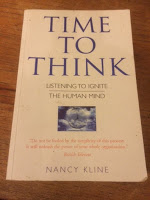
I have blogged before about Nancy Kline's book, Time to Think, and its underlying philosophy. As I made clear in that post, I am enthused about her approach, so I have booked on to her Thinking Partnership workshop, which I am attending next week (with Nancy, not one of the other licensed providers). I will report back in due course...

In the meantime, I have been reading her sequel, More Time to Think. This expands on, and to some extent updates, the previous work; and in particular has a good section on coaching, including some suggestions for the initial exploratory meeting with a new coaching client.

I was particularly interested in this as I had already identified, through conversations in supervision, that I wished to improve my initial meetings.  Kline's approach is simple, as one might expect, but also profound, as one also might expect.

She rightly points out that the two topics of conversation are what the individual wants from coaching, and how the coach coaches. I had already got that far in my previous version of the initial meeting. However, I recently conducted my first 'Kline-by-the-book' initial session, and it was very much better than my previous ones. 

So what have I changed as a result of reading More Time to Think?  There are a few things.

One is that I asked each question (such as 'What are your goals for this coaching?') several times. Even when I was pretty sure, and indeed the client had indicated, that he had said all he had to say, I asked it one more time; and to the surprise and delight of both of us, more good thinking flowed.  

The second is that I did not take any notes. This was a bit of a wrench for me, as I mistrust my memory; but the benefits outweighed that: in particular the quality of attention I was able to give him, and the ease of the whole session for him and for me. I asked a total of nine questions (each one several times) and that part of the conversation lasted for about an hour and fifteen minutes, with him doing 95% of the talking. The results of that were much greater clarity around, and commitment to, both the overall goals of the coaching, and the milestones along the way. I also got a far deeper understanding of the client and his context.

The third is that I worked particularly hard on my listening. My listening is normally good, but I can be tempted to join in the conversation. Instead, I refused that temptation consciously, and apart from reassuring noises (yes, uh-huh, etc), two summaries and the nine questions, I kept quiet, and really focussed on what the client was saying with utmost curiosity and delight.

Oddly (or perhaps not) I find that I did not need my notes to remember the conversation (though I made notes afterwards of the key ideas).

The other big change was the way in which I described, and we discussed, my role as a coach. I have blogged before about the way I describe my work in this context.  This time, I went down the route suggested by Kline, and said that my role was to help him to do his very best thinking; that he would be able to solve nearly all of his issues himself, and my job was to provide the support and stimulation for that to happen; and that I would only offer information or suggestions when we were both clear that his thinking had taken him as far as it could, and that he wanted more ideas. I talked him through the ten components of a Thinking Environment, and the underlying philosophy; and also discussed the need for feedback and honesty between us.

One more change: I got him to complete the relevant parts of the documentation: coaching goals, how we will check progress, and so on. He thought that was obviously his role (prior to this, it is something I have done after the meeting, working from my notes, and then sent back to the client to check). His observation was that it made sense for him to write the goals, both so that they were in his words, and as a practical act of commitment to them.  And it saved me a job.

We ended with mutual appreciation; which again was easier than I had thought it might be, due to the quality of listening, and the subsequent degree of interest and energy, I had invested in the process. 

So that feels like a successful initial session; not least modelling the fact that ownership and airtime both belong to him, and what my role is. 

I will certainly be using this approach again in my initial meetings; as well as being more rigorous in my using the rest of the Kline approach in future meetings, when it is appropriate.

Friday, 11 March 2016

Suzy Lamplugh Trust Update

For those who have been following the saga of my attempts to get the Suzy Lamplugh Trust to correct an (inadvertent, I am sure) error on their website, here is the latest instalment.

But before that, give me a second to bring new readers up to speed. I blogged a while back about the Mehrabian myth, the notion that  the words in a verbal communication account for  only 7% of the meaning we receive; the rest being voice (38%) and body language (55%).

I came across it again when being trained for the voluntary work that I do, and was told that the source of their (mis)information was the Suzy Lamplugh Trust. So I looked on the Trust's website and found  and they do not quote the figures there, but they do say  'The majority of communication is through body language, a lot through tone of voice and only a little through words.' (Their emphasis). I blogged about it here, including why it is so worrying in that context, and also wrote to the Trust.

In due course, I received a reply, which I thought might just be fobbing me off; so I resolved to re-visit the site after a while, and see if they had actually changed anything. They had not. So I wrote to the Chair of the Trustees, and this week received his reply.
Thank you for your email to me of 4th March. Having looked into this I really don't think that the information on the Trust's web-site is either misleading or dangerous. To the contrary, it is making an important and correct point: that body language is often more important than what one says and that it is important to be aware of one's body language if one is to defuse aggressive behaviour. As you have noted yourself, our web-site doesn't use the (often misquoted) Mehrabian percentages. Accordingly, I am satisfied that the responses you have previously received from the Trust's staff were appropriate and that they reflect the Trust's policy. I am grateful to you for bringing this issue to the Trust's attention. As a result of you doing so we have now reviewed this matter twice. However, we do not propose to review it again, at least not in the immediate future. Accordingly, we not intend to correspond with you further about this.
Beneath the formal courtesy, that sounds like a clear 'get lost.'  I note that at no stage has anyone from the Trust maintained that the statement is true, still less given any reference to support such an assertion.

However, never one to give up too lightly on helping people to learn, I tried one last shot:
Thanks for your email. I have no intention to waste your time, and do not expect a reply to this. 
However, I would point out that there is a vast difference between these two statements: 
 'The majority of communication is through body language, a lot through tone of voice and only a little through words.’
 'body language is often more important than what one says and [that] it is important to be aware of one's body language if one is to defuse aggressive behaviour.'
My only intention was to help you correct this inaccuracy - if you changed the wording on the site to what you wrote in your email, that would be telling the truth rather than telling an untruth. 
Perhaps it is my training as a linguist that makes this seem important to me. Try telling any student of a foreign language that 'The majority of communication is through body language,’ and you will see what I mean. 
I have little hope that it will do any good, but I will revisit their site occasionally, in the hope that the change will be quietly made.

And I continue to wish them well with the important work that they do.


If you agree with me that they should correct the site, you might choose to drop them a courteous line to that effect.  If you think I am wrong on this, you could drop me a line, of course.

Friday, 4 March 2016

Graphic Reporting

This week we ran another of our series of workshops thinking creatively about developing the Strategy at Cardiff University. This was focussed on the Learning and Teaching agenda, and was a very successful event. The element I want to focus on was the work of Eleanor Beer, who was there as our graphic reporter.

I've only once before worked with a graphic reporters like this, and I was struck by how powerful and valuable this is. Eleanor managed to summarise both the plenary sessions and the output from eleven syndicate groups in one large, colourful and clear poster.


This will both accompany the more formal report summarising the proceedings, and also be available as a stand-alone reminder for those who attended the event.

All of which made me wonder why I didn't do it more often. And the truth is that I was a little disappointed the first time.  The work produced then was less graphic and more heavily reliant on words; it also seemed, somehow, less additive. That is harder to analyse, but it felt as though the reporter was just catching the headlines, where Eleanor was capturing the spirit as well.


So I am re-enthused about the approach; but would also recommend selecting your graphic artist with real care, to ensure that you get the quality of output you want, rather than something that leaves you feeling disappointed.


Saturday, 27 February 2016

Media Training

This week we had the media training at Cardiff, as part of the Futures programme. I always enjoy this module. The first sessions were about the context and some experiences with the media, with Claire Sanders, who is Communications Director for the University, kicking off, with a very interesting overview of her team's strategy and work.  Then we had Richard Sambrook, who was with the BBC for thirty years, ending as Director of the World Service and Global News. He is now a professor at Cardiff, and gave a great insight into the world of news stories.  He was followed by Chris Chambers, another Cardiff professor, who has his own fascinating story to tell about being misrepresented by the media, getting caught up in a media frenzy, and now working with colleagues to improve the reporting of science in the media, including conducting fascinating research into University press releases.

For the rest of the event, we worked with Karen Ainley and Kevin Bentley, of Mosaic. they are both ex-BBC journalists, and they trained us in the art of radio and television interviews; first by getting us to understand the nature of the medium and the importance of key messages, and then by mock interviews on radio and TV. They were both excellent.

As we were working in BBC Wales, we had the benefits of a proper studio, with some of the Cardiff media team operating the cameras, sound and mixing desks. We also had a tour of the studios, which was both educational and extremely interesting.

I, too, did a couple of interviews, both to show solidarity with the participants, and to keep my hand in - and in fact the TV one may well appear on this blog in due course, as it was a shameless plug for my book, which I have finally finished, and is currently being proof-read.

Everyone was buzzing by the end of the programme, and many said how much they had learned and how much they had enjoyed the programme.


Friday, 19 February 2016

Clean Coaching

Today's CPD event at Cumbria Coaching Network was a session on Clean Coaching by Sioe Lan Tjao. I had come across clean questions many years ago when I did some NLP training, but either they weren't well explained, or I failed to understand the underpinning ideas.

And in my subsequent disillusionment with NLP, I approached today's session with some scepticism. It all seemed very interesting, and at one level, quite sensible: if as a coach one avoids introducing one's own stuff into the conversation, one is likely to be able to help the client to pursue his or her thinking further, without distractions. 

However, the particular questions suggested (there is a bank of twelve of them) didn't seem to me to be the only way to do this, and indeed I found it hard to understand why they had been chosen.  I suspect it was limitations of time, and the challenge of trying to cover a lot, and include some experiential work, that meant we didn't cover as much as Sioe Lan had hoped.

However, in getting home and following some of the links that she pointed to, I realised that the background to Clean Questions was an assumption, founded on the work of David Grove, about clients' use of metaphor, and the value of exploring that.

And as I read this explanation by Lawley and Tompkins, pursuing my curiosity about metaphor, I found something very interesting. The final example given, From Bombs to Batons, was remarkably similar, in effect, to the work on Story that I have been developing. That is, where I would see myself as helping a client to discover and strengthen a more helpful story, Lawley and Tompkins would see themselves as helping their client to change his or her metaphor.

That may sound like a very slim distinction; and indeed it is. But what I find fascinating is that although we are seeking to do essentially the same thing, the way in which we reached that point is very different; and so is the process we use to help the client. Which is just as well, or the book I've just finished writing would have been a complete waste of time.

Part of me is sorry that I had not come across their work before finishing mine; but part of me is very grateful indeed! It has already taken quite long enough, and there is plenty of scope for taking my thinking further, beyond the book.

Saturday, 13 February 2016

Thinking about Values

Lots of things have been prompting me to think about values and their relation to the work we do. We had a fascinating day in Cardiff recently looking at what it might mean to be a values-led Institution, informed by two of their philosophers, and also a guest speaker from Findhorn; but mainly drawing on the collective wisdom of the assembled academic and professional staff.  I have also been working with Winchester University on a similar agenda; as well as writing about my own practice for my ILM Diploma assignment; and most recently discussing possible futures for the SAgE Faculty at Newcastle, including the underlying principles of any strategy.

Thinking about all of these, I have not been able to come up with anything more potent and relevant for my own business than the classic articulation of Christian philosophy, building on Greek philosophy. That is, I see my business as being founded on the three pillars of faith, hope and charity, and run (as best I can) with prudence, justice, fortitude and temperance. 

Clearly, as I am a Christian, each of these has a supernatural meaning for me. But they also have a very definite here-and-now aspect, which I think is relevant to people of all belief systems, including agnostic or atheist ones.

Faith, in that sense, I associate very much with Viktor Frankl's insights on the importance of meaning (see here for more of my reflections on Frankl, and here for an external summary of his life and work). One of the things I do when I am working at my best is help people to find meaning in what they are doing and experiencing, and thus the belief that it is of worth and value (or if not, the belief that it is worth addressing that issue!).

Hope is foundational to my work. More than once, I have received unprompted the feedback that what I help people to do is to discover or re-kindle hope, and how powerful that is. That hope may be built on the realisation that we really can make a difference, that we can make the future better for ourselves and for others, and that however dreadful a situation one finds oneself in, our response to that, and to that extent our future, is open for us to influence: which of course links back to Frankl's work.

Charity is an orientation to the good of other people: seeking to do things for the benefit of others, and avoid things that will be against their best interests. First of all, do no harm... Again, I seek both to live like this, and to help others to do so. A lot of my work with conflict and negotiation is about seeking to get people to understand the perspective of their adversary; and that includes ceasing to view them as an adversary, but as a human being with rights and good intentions and good will.

Prudence, I think, has a bad press. I see it as being about taking courageous decisions, whilst avoiding being reckless. Again, that is something I strive to do myself, but most often see with admiration, and sometimes awe, in my clients. 

Justice is widely recognised as one of the fundamental values to which most organisations commit, and it is very clear that if employees, for example, sense inequity in their treatment, that is very bad for the organisation. Increasingly, organisations are looking beyond internal equity and adopting programmes of corporate social responsibility, to spread justice further afield. In the case of my business, that results in both directors giving significant time on a regular basis to a number of charities.

Fortitude is a virtue that I associate particularly with tenacity and with the courage to tell the truth, even when it is difficult or feels disadvantageous to do so. Again, these are values I strive to honour, but would have to declare them to be work in progress.

Temperance is another misunderstood virtue, in my view. It is the virtue of appropriate moderation. It curbs greed, arrogance and excess. That includes excessive value placed on work activities at the expense of all the other human activities which have a claim on us (our responsibilities to our families and friends, for example) or which would be good for us (such as staying fit). Thus it is closely associated in my thinking with that integration that is at the heart of work/life balance. 

I realise, as I write this, that I am setting a high bar; so I invite those who know me to hold me to these aspirational values, and to let me know each time I fall short of them. Only by constantly working towards them, I think, will I be able to run the business that I want to run.

Saturday, 6 February 2016

A Fun Piece of Technology

This week I was running an event with a large group, looking at whether a values-led strategy was a good idea. That included lots of other questions, of course, such as what we mean by values, and what we mean by values-led, and so on.

As well as the usual business of plenary sessions with questions, and syndicate work on case studies, we were keen to do some more participative work in plenary sessions, so we decided to experiment with Poll Everywhere.

This is a web-based solution that allows you to pose questions, and everyone to contribute their thinking, which is automatically, and immediately, displayed on the screen in your conference room. People contribute by logging into the site on their smartphone, tablet or laptop, which then displays the poll question and the options for answers.

So we were able to poll people on arrival, about whether they thought a values-led strategy was a good idea, with the options of Yes, No, and Don’t Know. The Yeses were the largest group, followed by the Don’t Knows.

We then asked why it might be a good idea, and offered a list of options for people to choose from. Likewise, we asked why it might not be a good idea, and again offered a list of options for people to choose from. Finally (in this opening session) we asked them what values they would like to see lead the organisation, and they could write whatever they wanted – the results being displayed as a word-cloud, developing in real time.  That of course meant that people were able to respond to what others were writing: once someone had written ‘Integrity’ many others did so too, so the word grew and grew on the screen.

Later in the day, we also used it to collect answers to a case study, which was read out in plenary; and at the end of the day, we polled them again about whether they thought a values-led strategy was a good idea. The Yeses were a significant majority, having gone up, whilst Don't Knows had gone down, and the Noes had also increased. All of which was interesting feedback both for us and for participants about how views had shifted during the day.

So it was a lot of fun. Participants visibly enjoyed the opportunity to take part in this way (and of course it is particularly good for those who don’t like speaking in front of groups). But it was fun with a purpose. It enabled both us and the participants to get a real sense of where the weight of opinion lay, in a very short space of time, and also how that shifted over time. 

At the end of the day, we were able to pull off a report, with graphics of all the votes and the numbers behind them. All in all, a very good package, at a reasonable cost (I think we paid $199 for a month's package, to enable us to build the questions, try them out and so on. Cheaper packages are available for smaller groups, and you can try it for free).


I will certainly be using it again; and judging from the comments on the day, so will many of those who attended the event.