Thursday, 24 February 2022

On bumping my head...

In our cellar, we have a low beam. Normally, without even thinking about it, I duck under it as I go from one side to the other. But occasionally I bump my head on it. And that is always when I am thinking of something.  I nearly said something else, but it is not that I am thinking of the beam normally - I just have a habit of ducking my head a bit. So it is interesting that if I am distracted from my normal routine of 'walk across the cellar' by something else - a grandchild, say - I often bump my head.

And that is consistent with various psychological experiments on multi-tasking (eg this research from Stanford). To try this out for yourself, try doing a fairly routine task, whilst counting backwards from 100 in threes.  You see what I mean?

All of which reminds me of the wisdom of something my very first boss in the training world taught me: OTAAT - one thing at a time.

What is interesting is that we know this, both from experience and from the research, and yet we are often tempted to do more than one thing at once: to check our email whilst in a meeting or talking to someone; or to interrupt our serious thinking work by checking the news headlines or the weather forecast.

Moreover, our work environments often seem to demand that we multi-task: how else will we get through the enormous volume of admin stuff we need to clear, before we can get on to our real work?  Yet that question is itself an illusion: we will rarely, if ever, clear all the admin we could possibly do, particularly if we work in a bureaucratic organisation. We must start form the other end: identify the best use of our time right now - the most important and urgent thing - and do that, to the exclusion of all else, at least for a period of time.

Of course we need to dedicate some time to staying on top of emails and so forth, but that should become second and be time limited: and when we are doing that, we should only be doing that.  Because ultimately, if we try to multi-task, not only will we be slower, less efficient and less intelligent, we may also hit our head on the beam...

--

Photo by No Revisions on Unsplash

Friday, 18 February 2022

Scott's Learning Cycle

Many of my readers (quite possibly all three of you) will be familiar with Kolb's learning cycle.  It's a neat way of suggesting how we learn from experience, and reminds us to attend to various aspects of that when we are learning or helping someone else to learn. 

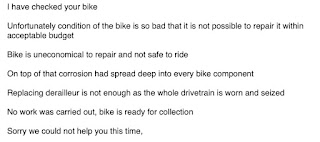
But recently I suffered a tragedy: the rear derailleur on my bike broke, and the bike shop said it was beyond economic repair.  In fact they went further and declared my bike dead on arrival, or as they put it, 'not possible to repair...not safe to ride... corrosion... deep into every bike component.

And as a way of mourning - and honouring - the passing of this bike, I thought I would reflect on how much it has helped me to learn, over the years: a bike I will fondly remember as my Learning Cycle.

Avid readers will remember how it helped me to become smarter than Sherlock Holmes, for example.  And how a fall from my bike helped me to recognise how I was developing my Inner Supervisor. 

You may also remember when I acquired the bike, a decade or so back, by dint of the excellent material on Negotiating Skills from Harvard (Getting to Yes) that I both teach and (on this as so many occasions) use myself.

But more profoundly, the bike has been part of my discipline, both of keeping fit and of learning, for many years now.  In this blog post, I reflect on that, including:

'Thus the discipline of getting out on my bike first thing every morning and cycling up the fells, come rain or shine, frees me in unexpected ways. At one level it is the obvious thing: being fitter makes me less prone to bugs, and being physically tired means I sleep well at night, free of insomnia. But it also frees me from rumination: I process a lot of thinking as I cycle.'


But, alas, my learning cycle is no more; but its legacy, in terms of the learning itself, will live on.

And I collect a new bike tomorrow (by which time I hope that they will have put the pedals on).

But what, asks Prodnose, has any of this to do with Kolb's Learning Cycle? to which I can only reply that such a question reflects a lack of abstract conceptualisation that shames him, before I hop on my bike and cycle off into the sunset...


Friday, 11 February 2022

Interrupting myself

The Promise that Changes Everything is the title of Nancy Kline's latest book on the Thinking Environment; and that promise is "I won't interrupt you."

Listening without interruption is at the heart of this powerful approach to helping others to think in your presence, about which I have blogged many times.  Nonetheless, as I continue to study and practice the Thinking Environment, I continue to learn, and so, unapologetically, here is my latest thinking (or at least, some of it).

The context was a meeting of five of us, interested in this work, in which we had agreed to listen to each person think, without interruptions, for 45 minutes each.

So it was fascinating that at least three of the five of us interrupted our own thinking, and typically about half way through the time. One person said 'I'm done,' and stopped; but when asked what more he thought, (and thus assured of our continued interest and given permission to keep going) he thought more. And that was repeated a couple more times, until he had thought for 45 minutes.

The second person stopped halfway through, and asked someone else: "What do you think?" but again, when assured that we were still interested in what more he thought, he continued to think for the remainder of the 45 minutes.

And a third person said, after about twenty minutes, "I must be boring you by now"again, when assured that we were still interested in what more she thought, she also continued to think for the remainder of the 45 minutes.

All of which led to interesting discussions and reflections. One thing that we have frequently observed is that thinking comes in waves.  Thus when someone has completed a wave of thinking, he may well think that he is done; however, if given permission, an invitation, and a stimulus in the form of a question, there is often a second (and third and so on) wave of thinking that arises.  And that is often the newer, fresher thinking, too.

But the other thing, most explicit in the third case, but we all thought it was a factor in the other two, is that sense that people can't really be expected to listen to us for this long!  And that was even the case when we had a clear agreement that that was precisely what we were wanting to do.  We also reflected on the fact that whilst each thinker had feared that he or she might be boring the rest of us, each of the listeners had been completely fascinated by each thinker's journey.  And we all enjoyed the fact that each thinker reached some valuable places with their thinking.

So one of the dynamics is clearly that many of us are socialised into thinking we shouldn't go on too long or we will bore people. In many social contests, that is a useful thing to understand; but it was fascinating to experience how difficult that was to over-ride that, even when we had a clear contract around the time, and knew that each of us was going to get the same chance to think - and that in this context, going on was not boring. 

A final reflection was how this demonstrates why thinking with a thinking partner or listener is different from thinking on our own. On our own, we often interrupt ourselves or get distracted: with a thinking partner who is genuinely interested in where we may go next with our thinking, that doesn't happen so much.  And on our own, we may get to the end of a wave of thinking and think "I'm done." With a good thinking partner there, to sustain generative interest and ask a skilful invitational, and completely content-free question (such as 'What more do you think, or feel, or want to say?') we may discover that there are many more waves of thinking to enjoy, and that they take us somewhere completely unexpected, and often very valuable.

--

With thanks to Mimi Thian for sharing this photo on Unsplash

Thursday, 20 January 2022

Cat or No Cat?

I had introduced the group to the Harvard model of negotiating (as outlined in Getting to Yes) and they had discussed some of their negotiations in small groups. In the discussion following, one woman said: My issue is about a cat. My husband wants one, and I don't. There's really not much room for negotiating.

I mentioned that in the Harvard model, rather than focusing on the positions (I want a cat! versus I don't!) we would look at the underlying interests. What was it that her husband wanted from having a cat?  What was it about having a cat that was so objectionable to her?

But, of course, they had done that work in the group, in the hope of inventing a new option that both would be happy with: and various other pet options had been suggested, ranging from squirrels to rabbits (and including, of course Schrödinger's cat...), and indeed occasional cat-sitting for a neighbour; but none of these possible solutions were suitable. So it really did look like a zero sum game. 

But I continued to think about this conundrum afterwards, and realised with hindsight that I had missed a valuable teaching moment. For another aspect of the Harvard model is to insist on objective criteria.  The intention here is to remove coercion from the discussion, so that neither party bullies, or feels bullied by, the other; and in a matrimonial relationship that strikes me as particularly important.

Clearly, when deciding whether or not to have a cat as a pet, objective criteria are hard to find. But the second-level aspect of this insight is fair process - and that is something I could have explored with my group. 

When teaching this in a longer context (eg a day's workshop on negotiating) I often talk about voting and democracy. I make the point that we don't vote because we believe the majority is always right (we have plenty of evidence from history that such is not the case) but rather because it stops us from killing each other. It removes coercion from the system, by offering a transparently fair process (at least, in theory - I don't want to get into a discussion of the current aberrations of democracy in this post...).

Clearly, in a matrimonial disagreement, voting doesn't apply, as you will get a 1:1 hung vote. But the principle could be applied. For example, both parties could agree to toss a coin, and be bound by the result. And if that feels too much like setting up one person to win, and the other to lose, one could add a further element to the agreement: that whoever gets their wish on this issue, must agree in advance to cede the right to decide the next contested decision to the other person. That would be interesting...

I wish I'd thought to raise this and explore it with the group the other day: I am sure that they would have had some interesting insights. Instead, I'll email them a link to this blog post, and pick it up with them next time we meet. 

--

With thanks to  Alvan NeeElliott Stallion and  André François McKenzie for sharing their photos on Unsplash

Friday, 14 January 2022

Where do we stand?...

Where do we stand, if we demolish all our assumptions or beliefs? 

We can't of course; but the question arises for me as I continue my study and practice of Nancy Kline's Thinking Environment. One of the powerful parts of this work is to help people to identify untrue assumptions that are blocking their thinking, and replacing them with true and liberating assumptions. 

An example I encountered was someone who had come across serious wrongdoing at work and said she didn't know what to do. I was puzzled, as whistle-blowing protocols were clear and she was in a role where she would have known that. However, I assumed (as Kline would advocate) that her thinking was blocked by an untrue assumption, and proceeded to investigate. On reflection, she thought that the assumption that was blocking her thinking was that if she were to blow the whistle, she would get the sack.
Now, the hypothesis in the Thinking Environment work is that it is only untrue assumptions that block our thinking. So I asked her if she thought that this was true. She said that it might be; and I had to agree. So we proceeded to look for the untrue assumption nested within that true assumption that was blocking her thinking. After some hard thinking and long silences, she identified it: she assumed that if she got the sack from this place, she would never work again. 

Once she had articulated that, she realised that it was untrue, and was able to experiment with a true and liberating assumption: that even if she got the sack from this place, she would be able to find another good and fulfilling role. And that unlocked her thinking: she was able to map out the path to take, and then to take it. So far, so good. 

But this questioning of assumptions can be infinitely regressive. 

Kline teaches that we can assess the truth of an assumption (which is crucial to this work) on the basis of facts and logic. But that, of course, rests on several assumptions. And so on. 

Consider this rather more complex case. A woman was talking about her life; she concluded that she would have more fun if she were to leave the man she was married to. The assumption that was blocking her thinking about how to do this was that she should stay with him. How does one assess such an assumption, using facts and logic? The number of facts and potential facts that might have a bearing on such a moral issue is almost infinite; and logic cannot answer with absolute finality questions about, for example, the impact of such a decision on their children. 

Finally, such moral decisions are philosophical ones: what philosophy do we choose to inform our decisions? Or, to put that another way, what assumptions are we going to take as bedrock?


So my view is that we can't proceed without assumptions; but it is important to be clear what those assumptions are, and why we are choosing to honour them. Otherwise, we risk sawing off the branch we are sitting on, and then where do we stand? (to mix my metaphors rather too graphically...) 

--

With thanks to Tbel Abuseridze for sharing photos on Unsplash

Friday, 17 December 2021

Finding Freedom through Discipline...

There is something of a paradox about freedom and discipline, that I am reflecting on as the year comes to a close. It seems to me, that the more I stick to certain disciplines that I have chosen (around exercise, meditation, structuring my work and others), the more freedom I experience.

This morning's view...
Thus the discipline of getting out on my bike first thing every morning and cycling up the fells, come rain or shine, frees me in unexpected ways. At one level it is the obvious thing: being fitter makes me less prone to bugs, and being physically tired means I sleep well at night, free of insomnia. But it also frees me from rumination: I process a lot of thinking as I cycle.

Likewise, the discipline of meditation frees me from worry and stress in significant ways; and the discipline of structuring my coaching sessions (and various other 'sandwiches' about which I have blogged previously) frees me to be emergent in a lot of my work, whilst knowing that I am doing a good job. 

In the same way, the freedom to follow my inclinations (to laziness, to one more glass of wine, to... well I don't want to get too confessional here) clearly limits my freedom to do what I truly want to do. This of course links to my previous musings about artificial authenticity; and to the research about delayed gratification which I refer to in this post about what I really want to do.

So I offer these as some reflections, as we approach that time of year when we start to think about New Year's Resolutions (and if you want some help formulating those so that they work, I blogged about this at the start of the year, here).

This will (almost certainly) be my last post of the year, so I wish all my clients, colleagues, friends, and any other readers every blessing for a restful and restorative Christmas break, and a rich and stimulating New Year.

--

With thanks to Mona Miller for sharing her photographs on Unsplash

Friday, 10 December 2021

In a crisis...

I heard a great anecdote this week about some experts on Crisis Management from (I think) Harvard. They begin their presentation with a series of slides: 

1    In a crisis...
2    Either the crisis manages you...
3    Or...

.... and then ask the participants to respond.  Apparently, wherever and whenever they do this, they always get the same response; '... or you manage the crisis.'

Which, they then go on to say, is the wrong answer.  (In passing, it interests me that the structure of the question so reliably prompts that response: are we so conditioned to think in clichés?... but that is not my main point).

The correct answer, according to them, is '... or you manage you.'  Their point being that it is of the nature of a crisis that it is unmanageable: that is almost a definition of a crisis. But what we can manage is our response to it.

And that makes perfect sense to me. It also accords with the insights of Viktor Frankl (qv)  and his observation (hard-won in the concentration camps) that 'Everything can be taken from a man but one thing: the last of the human freedoms - to choose one’s attitude in any given set of circumstances, to choose one’s own way.' 

Which is all well and good: but how does one manage oneself in a crisis?

One part of an answer is all the work on resilience, about which I have blogged before a few times (here for example).

Another aspect is to do with awareness: so that we understand our particular, and predictable, responses if we are starting to lose control of ourselves; that is, if we are not moderating our thinking and behaviour as well as we usually do. And that is precisely what the Hogan Development Survey (or Dark Side as it is popularly known) looks at.

So it is no coincidence that the Dark Side behaviours that the tool explores are grouped in fight (moving against) and flight (moving away) categories, with an additional two that are about ingratiating (moving towards).

Thus the fight behaviours are those labeled bold, mischievous, colourful and imaginative; the flight behaviours are excitable, sceptical, cautious, reserved, and leisurely; and the ingratiating behaviours are diligent and dutiful. It is worth saying that these labels are not always helpful, and often looking at the subscales in each category sheds more light on what it encompasses. Thus leisurely is a combination of passive aggressive, unappreciated and irritated.

So it is helpful for me to know, via the Dark Side tool, that the warning signs I need to look out for,  that suggest I am losing control, are those associated with colourful, reserved, and imaginative. Thus if I feel inclined to start to show off (colourful), withdraw (reserved) or suggest ever more, and ever more bizarre, ideas (imaginative), it is likely that I am not self-moderating as well as I usually do.

That knowledge no only acts as an early warning system, as it were; but also provides me with a longer term strategy to work to address these tendencies, should I wish to do so.

And if I put all these disciplines in place, and then, in a crisis, simply pause, breathe, count to ten, and then access all this understanding, I may just be better placed to manage my response to it.