Friday, 27 February 2026

Learn how to facilitate groups brilliantly

Do you run team meetings, facilitate learning events, chair boards or executive groups, or in any other context, get people together to think about important things?  Do you ever find that people don't contribute as well as you would hope, or that some dominate and others don't contribute?

 If you wish to take your skills in running groups to the next level, and develop a set of approaches that increases participation, honest discussion and real engagement, then you will find it valuable to engage with the Thinking Environment.

This is based on Nancy Kline's work, published as Time to Think, More Time to Think, and The Promise that Changes Everything.

At the heart of Nancy's approach, which she calls a Thinking Environment, is the belief that attention is generative; that is, the quality of someone's thinking, in my presence, is at least in part a product of the quality of attention that I give to them. (if you doubt this, consider the reverse: when you are trying to think about something and the person who is meant to be listening is clearly not attending... see what I mean?). When all members of a team or meeting are offering genuine attention to whoever is thinking at that moment, the results are extraordinary - for all participants.
But in addition to a quality of attention that is in fact rare in most work contexts, there are nine other components of a Thinking Environment; and there are various applications of these components that are suited to both group and one-to-one contexts.

This system of components reliably creates an environment in which people really do attend to each other, and indeed value each other, bringing out the best of all in a relaxed, purposeful and powerful way.

The Foundation Programme is an introduction to this work in the context of working with groups: a precise but easeful approach to enabling all present to think outstandingly well.  I have blogged previously about this many times, ranging from my initial exploration of the process with Nancy, through to its practical application in a coaching session. (Other posts may be found by clicking here).

So I am delighted once more to be offering the Foundation Programme in the Lake District, this June (25/26). This Programme teaches you the ten components of the Thinking Environment, and a number of practical applications and findings that will transform your meetings.

Article content
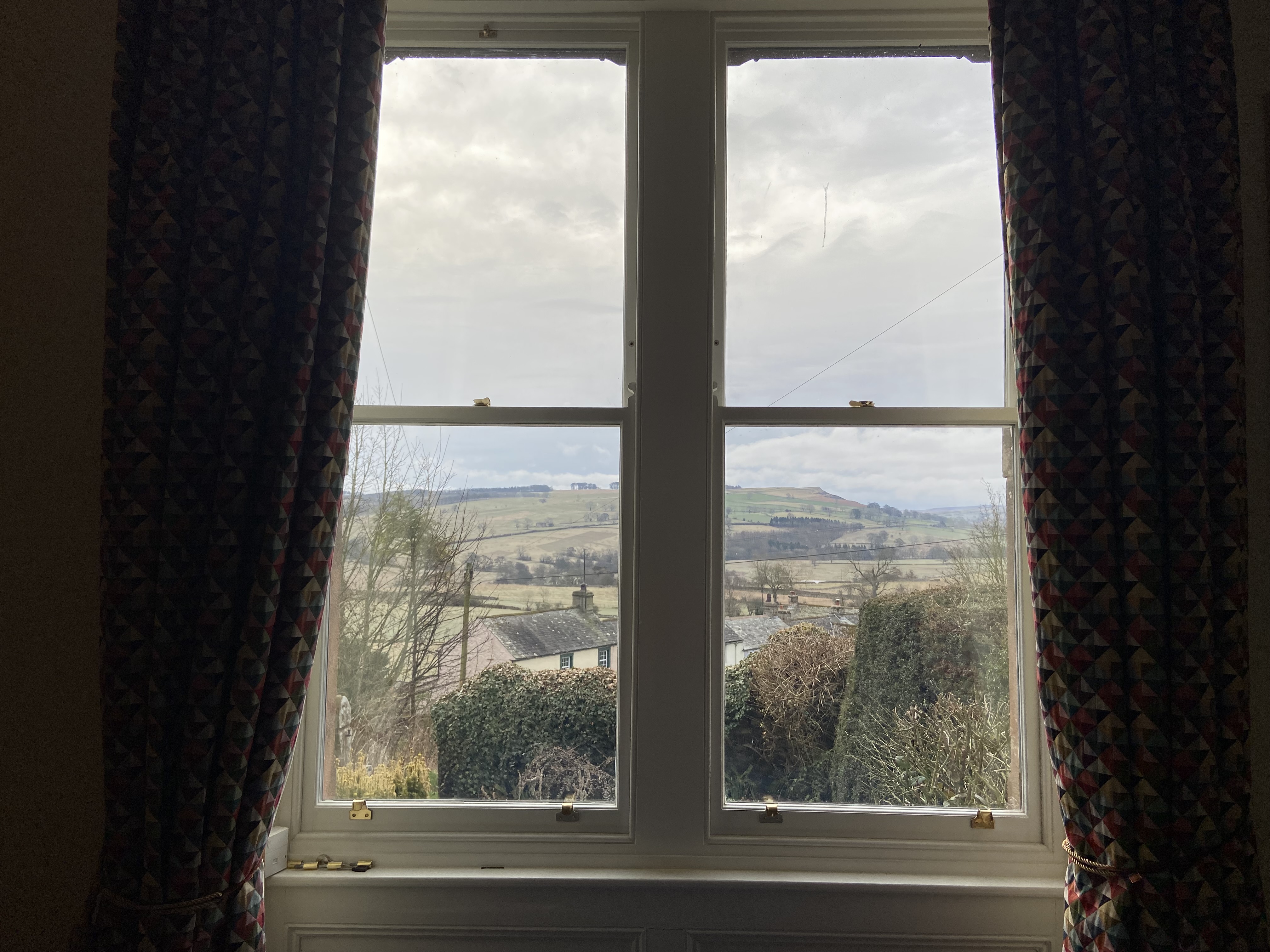
A walk to this view is an optional extra!

If you choose to join us, you will be working as part of a small group of practitioners, jointly exploring the practice through practice!  Here's what a previous participant had to say about one of my programmes:

I really enjoyed the practice based approach you used throughout. Your role in the group was perfectly pitched - it felt like we were a group of equal thinkers, but you had more insight into the approach, which you shared generously with us. I really appreciated you sharing your experiences of using the approach in different contexts and also current knowledge of changes and  discussions with Nancy. This felt as if we were up to date with the latest thinking.

This course is a prerequisite for the Thinking Environment Facilitator Qualifying Course, should you wish to take your practice to the next level.

More details are on my website, here; and of course if you wish to talk about the programme, or have any questions, I'd be delighted to hear from you.


Thursday, 26 February 2026

Over-thinking

As an advocate of thinking - and generally of thinking more, rather than less, than we usually do about any complex or fraught issue - I sometimes wondered about people who accused themselves of over-thinking. What did they mean? I sort of got it, but my instincts rebel against the term. Can one really think too much?

I suppose that if one delays necessary decisions and actions on the pretext of thinking further, that would be problematic. But in general, that wasn't the context in which I heard the comment. 

As so often, it is my coaching clients who have helped me to work out what I think.  So just recently, I have had some interesting discussions with a few people about rumination. And that label - rather than over-thinking- seems more helpful to me. 

Further, in discussing the issue with someone who worries about her tendency in that direction, we had some useful insights. Initially, we wondered if the difference was that useful thinking (what I call thinking) was solutions-focused, whereas ruminating tended not to be.

But we discarded that: we could both think of examples from our own and others' experience where issues without a potential solution could be the subject of either kind of thinking.

So what we settled on was intentionality; and in two senses.  Rumination often happens uninvited; and also often has no clear purpose. Whereas thinking is generally purposeful, in both those ways: one chooses to think about a particular issue, and one has some sense of purpose in doing so, even if it is merely to reflect on the awfulness of the situation. 

At least, I think so.

Thursday, 5 February 2026

On Being A Thought Leader

I have always wondered about people who style themselves ‘Thought Leader.’ How does one gain such a title? Is there a secret Professional Organisation of Thought Leaders United for Creating Knowledge (POTLUCK) of which I am unaware? 

But here I am, claiming to be one - albeit in a slightly different sense.  For I find myself leading (for want of a better word) a team of academics and professionals who are putting on a Thinking Conference in Durham (#TEinHE26). 

Team members volunteered to take responsibility for different aspects of the event: so there are people working in pairs or threes on all sorts of things: some selecting and organising the speakers, others doing the comms and marketing, others the website and so on. 

Because we are all Thinking Environment practitioners, it seems appropriate to try to lead this in a Thinking Environment kind of way - that is principally by creating the space for them to think together, individually and in small teams, about what they need to do. 

So I convene a meeting every four weeks where people think together about where they are up to and what they need from others to proceed. So in that sense I am a thought leader: I convene meetings in which people think, in pursuit of the delivery of a project.  

And for the sake of honesty, it is hard work to lead a team in that way. I don’t know what’s going on for weeks at a time. I get nervous. What if they have forgotten this, or not got on with that? The desire for control is strong.

And then, we meet: they say where they are up to, they exceed my own and each others’ expectations, they have thought intelligently and acted with authority. It’s going to be great (I think… but a bit nervous till the next meeting…)

As one of the team said, too often a team is gathered, full of enthusiasm for the project, and that is quickly hammered out of them by micro-management. This way people feel genuinely valued, everyone listens to everyone, so everyone knows what’s going on in broad terms, and what others need of them, and by when. And we generate great ideas together. The team is buzzing. And the Thinking Conference (which will run on the same principles: inviting people to think together about the different presentations) will be great!