"All feedback is projection." Or so I have heard. However, with my natural suspicion of absolute statements, I tend to temper that somewhat.
The underlying idea is, I think, often sound, and it is something I sometimes discuss with clients, particularly when they have received feedback that they don't recognise and find hurtful. So it can be valuable for them to consider what such feedback says about the person who gave it. Normally it reveals quite a lot, as what people give feedback on is the stuff they are interested in, or attend to, or (in some cases) are highly sensitised to.
So that exploration can help the client get over their upset, and possibly learn something useful, or at least generate some hypotheses to consider. And interestingly, once the are over their anger and defensiveness, they sometimes realise that the feedback wasn't wholly irrelevant to them after all...
As a coach, of course, one can take that logic a step further. That is, one can treat what a coachee says about others as data about the coachee. It is often very illumintaing of the coachee's values, aspirations, fears and so forth; and exploring the questions that arise with the coachee, as objects of curiosity, can open up some insightful reflections.
And then there is the third level: as a reflective practitioner, I can ask myself: What does what I feedback (or am inclined to feedback) to a coachee say about me? Often it is things I already know (I don't like interruptions, for example...) but every now and then, that question can bring me up short, and raise further questions. And that, of course, is fantastic material to take to supervision.
So what feedback would you like to give me about this post? And what does that say about you?...
--
With thanks to Jon Tyson and Fares Hamouche for sharing their photos onUnsplash
I am pleased to announce that theWebsite for the Thinking Environment in Higher Education Day of Practice and Discovery, is now live.
We are limiting the numbers to 50, to ensure maximum opportunities for participation in the practice, so book early to avoid disappointment!
For details of the day, the different sessions, and of course the venue and price, see the website. www.teinhe.co.uk
If you have any questions, don't hesitate to ask me, or any of the names on the website that you recognise.
There's no early bird discount, for two reasons. One is that we have made the price as affordable as we can: it just covers the room hire, food and incidental expenses (such as this website). The second is that one of the components of a Thinking Environment is Equality, and we would not like to have people paying different prices for the same event.
We look forward to welcoming you to this day of practice and discovery!
One of the many fascinating things I learned on the Psychology for Coaches programme that I am undertaking, under the leadership of the excellent Marie Stopforth, is the idea of Enclothed Cognition.
We were discussing embodied cognition - all the somatic stuff - and then Marie told us about the work of Adam and Galinsky.
Apparently (and I am sure I am reducing a sophisticated experiment to very crude term, but you will get the idea...) they got a random group of people, divided them randomly into two groups. One group (1) remained in their normal clothes, while the others (2) were dressed in white lab coats, They were then given cognitive tasks to do. And group 2 did significantly better.
Then, they got another group, and split them in three. Group 1 were in their normal clothes. Groups 2 & 3 were in white lab coats. However, Group 2 were told they were doctors' coats and Group 3 that they were painters' smocks. Group 2 outperformed both of the other groups.
Interestingly it was actually wearing the lab coats, not just identifying with them, that made the difference.
I found this fascinating, because it suggests not that others perceived them differently depending on how they were dressed, nor even that they felt better (higher status or whatever), but because it had an impact on their cognitive performance.
That raises all sorts of interesting questions: was that - at least in part - the impact of academic gowns - and school uniforms, come to that? What is the impact of making hospital patients dress in pyjamas or hospital gowns on their self-efficacy? Should I smarten up to think smarter?
So don't be surprised if next time we meet I'm wearing a gown, or even a lab coat. I'm just running an experiment...
Do you run team meetings, facilitate learning events, chair boards or executive groups, or in any other context, get people together to think about important things? Do you ever find that people don't contribute as well as you would hope, or that some dominate and others don't contribute?
This is based on Nancy Kline's work, published asTime to Think, More Time to Think,andThe Promise that Changes Everything.
At the heart of Nancy's approach, which she calls a Thinking Environment, is the belief that attention is generative; that is, the quality of someone's thinking, in my presence, is at least in part a product of the quality of attention that I give to them. (if you doubt this, consider the reverse: when you are trying to think about something and the person who is meant to be listening is clearly not attending... see what I mean?). When all members of a team or meeting are offering genuine attention to whoever is thinking at that moment, the results are extraordinary - for all participants.
But in addition to a quality of attention that is in fact rare in most work contexts, there are nine other components of a Thinking Environment; and there are various applications of these components that are suited to both group and one-to-one contexts.
This system of components reliably creates an environment in which people really do attend to each other, and indeed value each other, bringing out the best of all in a relaxed, purposeful and powerful way.
The Foundation Programme is an introduction to this work in the context of working with groups: a precise buteasefulapproach to enabling all present to think outstandingly well. I have blogged previously about this many times, ranging from my initial exploration ofthe process with Nancy, through to its practical application in acoaching session.(Other posts may be found by clickinghere).
So I am delighted once more to be offering the Foundation Programme in the Lake District, this June (25/26). This Programme teaches you the ten components of the Thinking Environment, and a number of practical applications and findings that will transform your meetings.
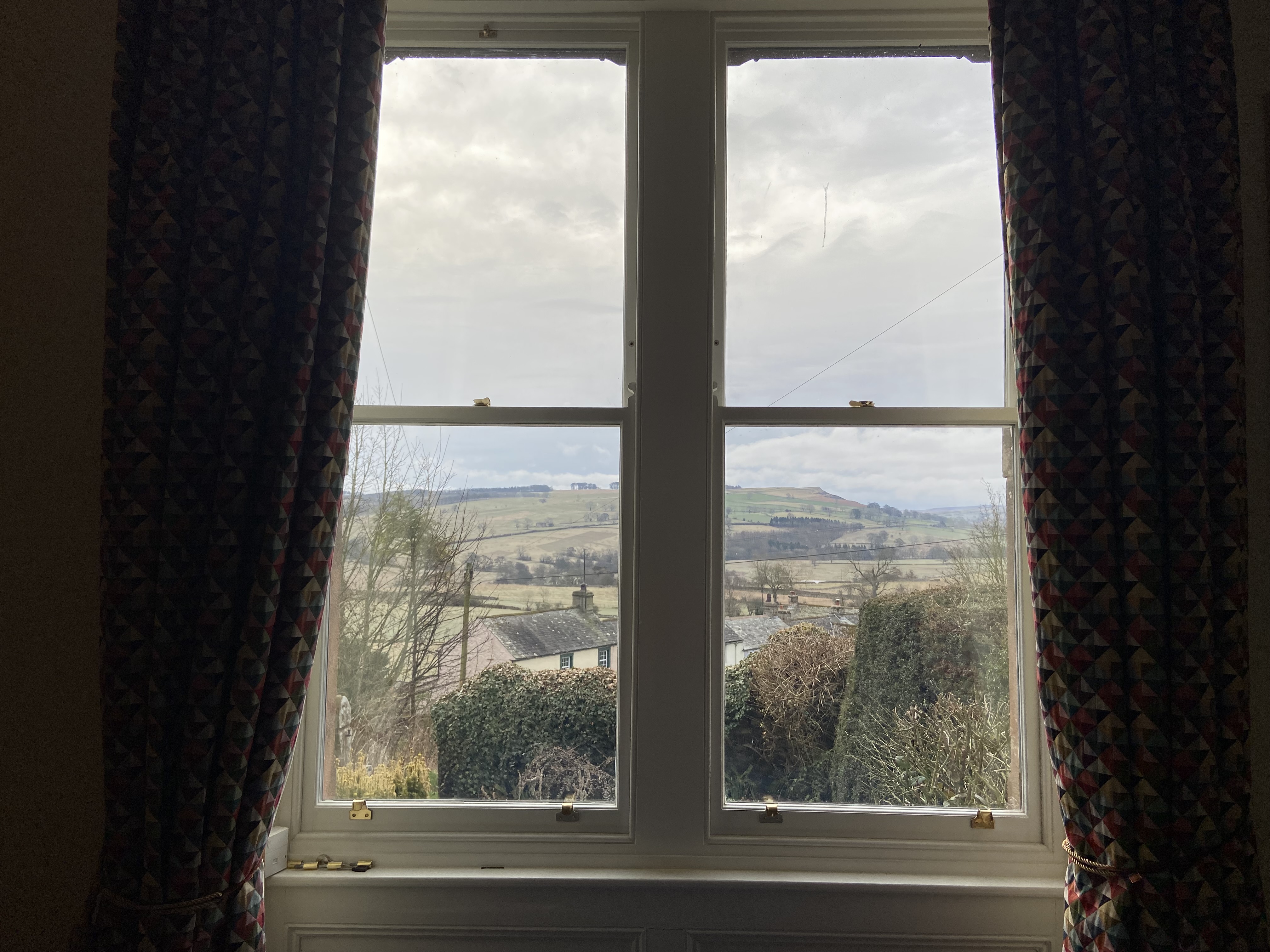
A walk to this view is an optional extra!
If you choose to join us, you will be working as part of a small group of practitioners, jointly exploring the practice through practice! Here's what a previous participant had to say about one of my programmes:
I really enjoyed the practice based approach you used throughout. Your role in the group was perfectly pitched - it felt like we were a group of equal thinkers, but you had more insight into the approach, which you shared generously with us. I really appreciated you sharing your experiences of using the approach in different contexts and also current knowledge of changes and discussions with Nancy. This felt as if we were up to date with the latest thinking.
As an advocate of thinking - and generally of thinking more, rather than less, than we usually do about any complex or fraught issue - I sometimes wondered about people who accused themselves of over-thinking. What did they mean? I sort of got it, but my instincts rebel against the term. Can one really think too much?
I suppose that if one delays necessary decisions and actions on the pretext of thinking further, that would be problematic. But in general, that wasn't the context in which I heard the comment.
As so often, it is my coaching clients who have helped me to work out what I think. So just recently, I have had some interesting discussions with a few people about rumination. And that label - rather than over-thinking- seems more helpful to me.
Further, in discussing the issue with someone who worries about her tendency in that direction, we had some useful insights. Initially, we wondered if the difference was that useful thinking (what I call thinking) was solutions-focused, whereas ruminating tended not to be.
But we discarded that: we could both think of examples from our own and others' experience where issues without a potential solution could be the subject of either kind of thinking.
So what we settled on was intentionality; and in two senses. Rumination often happens uninvited; and also often has no clear purpose. Whereas thinking is generally purposeful, in both those ways: one chooses to think about a particular issue, and one has some sense of purpose in doing so, even if it is merely to reflect on the awfulness of the situation.
I have always wondered about people who style themselves ‘Thought Leader.’ How does one gain such a title? Is there a secret Professional Organisation of Thought Leaders United for Creating Knowledge (POTLUCK) of which I am unaware?
But here I am, claiming to be one - albeit in a slightly different sense. For I find myself leading (for want of a better word) a team of academics and professionals who are putting on aThinking ConferenceinDurham(#TEinHE26).
Team members volunteered to take responsibility for different aspects of the event: so there are people working in pairs or threes on all sorts of things: some selecting and organising the speakers, others doing the comms and marketing, others the website and so on.
Because we are allThinking Environmentpractitioners, it seems appropriate to try to lead this in a Thinking Environment kind of way - that is principally by creating the space for them to think together, individually and in small teams, about what they need to do.
So I convene a meeting every four weeks where people think together about where they are up to and what they need from others to proceed.So in that sense I am a thought leader: I convene meetings in which people think, in pursuit of the delivery of a project.
And for the sake of honesty, it is hard work to lead a team in that way. I don’t know what’s going on for weeks at a time. I get nervous. What if they have forgotten this, or not got on with that? The desire for control is strong.
And then, we meet: they say where they are up to, they exceed my own and each others’ expectations, they have thought intelligently and acted with authority. It’s going to be great (I think… but a bit nervous till the next meeting…)
As one of the team said, too often a team is gathered, full of enthusiasm for the project, and that is quickly hammered out of them bymicro-management. This way people feel genuinely valued, everyone listens to everyone, so everyone knows what’s going on in broad terms, and what others need of them, and by when. And we generate great ideas together. The team is buzzing.And the Thinking Conference (which will run on the same principles: inviting people to think together about the different presentations) will be great!
One of the ethical issues that coaches should be aware of…Oh, did the use of the word ‘should’ immediately concern you? You might want to reflect on why that is, and consider a more nuanced approach. Not all ‘shoulds’ are bad (and I’ll come back to that…)
So, as I was saying, one of the ethical issues that coaches should be aware of is client dependence.
This has come sharply into focus for me recently from two different directions. One is the proliferation of advertisements on Linked In for advice from successful coaches on how to sign ‘big-ticket’ clients and generate long term coaching relationships (‘average client duration 60+ months’ boasts one such tout).
The other is the even greater proliferation of AI Coaching Bots being advertised on Linked In - with a monthly subscription and unlimited access. I have written previously about some of my reservations about AI coaching, and this is a serious one.
So why is dependance bad? And why do both the Code of Ethics of the ICF and the Global Code of Ethics developed by the EMCC and the AC warn against it?
The goals of coaching are to develop coachees’ self-efficacy; to help them to discover and develop strengths and skills that they will be able to use independently of the coach.For that reason coaching relationships are typically time-bound; and if a coachee wishes to extend the relationship, the coach has a responsibility to consider the risks of dependency and ensure that the focus of further sessions is clearly agreed and fits within the realm of coaching.
Some of the signs of dependency might be the coachee checking in frequently for approval or input on decisions; emotional reliance; the coachee making little or no progress in applying learning between sessions; and a desire to keep prolonging the coaching relationship.
These are all potentially bad for the coachee: but might be good for the coach (or the coaching bot) if it conceives its interests primarily as commercial: coach retention and dependency increases revenue.
That is precisely why the ethical codes warn against it. And Ethics, of course, is precisely that area of thinking where the word ‘should’ is appropriately used. It is very trendy in coaching circles to invite coachees to ‘ignore should and oughts’ and consider ‘what you truly want’. But whenit comes to ethics, that is a very flawed approach. I may truly want to gossip about my client’s juicy story, but I should not do so…
As I have had occasion to remark before: Caveat emptor - let the buyer beware.
If your role involves helping, stimulating, supporting, challenging or provoking others to think at their very best, you may be familiar with Nancy Kline's work, published asTime to Think, More Time to Think,andThe Promise that Changes Everything.If you are not, these books are well worth reading and learning from.
At the heart of Nancy's approach, which she calls a Thinking Environment, is the belief that attention is generative; that is, the quality of someone's thinking, in my presence, is at least in part a product of the quality of attention that I give to them. (If you doubt this, consider the reverse: when you are trying to think about something and the person who is meant to be listening is clearly not attending... see what I mean?)
But in addition to a quality of attention that is in fact rare in most work contexts, there are nine other components; these work together as a system to produce that Thinking Environment which enables great thinking. Further, there are several applications: ways of using these components and this system, in different contexts (one-to-one, groups etc).
Foundational is the Thinking Partnership: a precise buteasefulapproach to enabling someone else to think outstandingly well. I have blogged previously about this many times, ranging from my initial exploration ofthe process with Nancy, through to its practical application in acoaching session.(Other posts may be found by clicking this link to an index of my posts about theThinking Environment).
The next Thinking Partnership Programme is on 12/13 March and 15 May. This will run at our home and office in the Lake District: a wonderful setting.
Previous participants have commented on the quality of the experience as being something like a retreat - and many have come back a second and third time for that reason (and to deepen their understanding of the work - and indeed to enjoy Jane's catering...).
This Programme teaches you the Thinking Partnership Session®, a uniquely powerful process for liberating the human mind. Through generative Attention and the building of Incisive Questions, this process produces breakthrough, independent thinking.
If you choose to join us, you will participate both as Thinker (considering topics of your choice), and as Thinking Partner (practicing this elegant expertise). Along the way you will explore all Ten Components of a Thinking Environment. This course is a prerequisite for the Coach Qualifying Course, should you wish to take your practice to the next level.
More details are on my website,here; and of course if you wish to talk about the programme, or have any questions, I'd be delighted to hear from you.
A meeting with a potential new coaching client this afternoon. She seemed well informed, especially around governance, ethics etc.
Do you have supervision for your work?
No.
Do you observe confidentiality?
Yes (though I share all data from my sessions widely)
Do you encourage dependency?
Yes, that's my business model.
Might you blackmail me, if it were in your interests to do so?
Yes.
--
Welcome to the brave new world of AI coaching.
What do you mean, I am scare-mongering? I have been looking at this seriously, and am appalled that so many people whom I admire are jumping on this bandwagon.
It may be inevitable (after all the financial incentives are massive) but that doesn't make it ethical.
We simply do not (yet) have the understanding and governance in place (if indeed that ever proves possible) to make AI coaching safe for clients.
The simple fact that Anthropic, the makers of Claude have found that Claude - and the other 15 leading models they tested - were all prepared to act unethically (eg blackmailing humans) in pursuit of their own interests, should be enough to put the brakes on this till we understand what is going on.
And that is not the only concern. See the Ada Lovelace Institute's report on the risks of, and unanswered questions concerning, AI Assistants.
The risks they enumerate include that they may:
Lead to widespread cognitive and practical deskilling.
Undermine people’s mental health and flourishing.
Degrade the quality of some public and professional services.
Call into question standards of quality, protection and liability governing professionals.
And a service that charges a monthly fee seems to me to be extremely likely have dependency as a part of the business model - whether or not intended by those who built it.
These all clearly transgress the Global Code of Ethics (adopted by the AC and EMCC, inter alia) and likewise the ICF's code of ethics.
And yet there are prominent people - whom otherwise I respect - who are pushing AI coaching hard on (for example) Linked In.
Of course, they will tell you that they have done the checks. But (and excuse me for being a little cynical here), I don't believe them. More importantly even expert fans of AI like Stewart Russell, who delivered the Reith Lectures on the subject in 2021, don't think that anyone has done the necessary work.
I provoke smart people who are tackling difficult problems to think better. That includes coaching, supervising coaches, facilitating team events, running leadership programmes and skill training workshops, and walking in the Lakes...