Showing posts with label Nancy Kline. Show all posts

Wednesday, 10 September 2025

Freshest thinking...

This morning I started my latest CPD: a 6-month programme on Psychology for Coaches, run by Marie Stopforth for the Curious Coaching Company.

One of the points Marie made in this introductory session was the importance of holding theories lightly, engaging with them with curiosity, and always as a means to an end - the client's increased self-awareness. As an example, she mentioned Self Determination Theory (SDT), and how an understanding of the three components of motivation that it suggests (perceived autonomy, perceived competence, and perceived relatedness) might inform the questions one explored with a client who declared he or she felt unmotivated; but also that one should not be so wedded to the theory that one believes one knows what is going on for the client.

And of course that makes sense; it might be a useful framework in that context, and holding it lightly is a good approach. 

But what also occurred to me, as we reflected in small groups, was that SDT might additionally offer an insight into the effectiveness of Kline's Thinking Environment - an approach I favour.

Famously, this involves a much less directed approach to questioning (so the questions would not be informed by SDT). However, I think the Thinking Environment process is designed to strengthen all three of these areas.

In terms of perceived autonomy, the Thinking Partner's (ie Coach's) belief that the Thinker can address their own issues without any input or directive questions from the Thinking Partner maximises the Thinker's autonomy. The same is true of perceived competence: the Thinking Partner champions the Thinker's ability to resolve their own issues, believing in it even when the Thinker may start to doubt it. And the experience of being listened to with the quality of attention that the Thinking Environment is famed for, along with the other components of Appreciation, and Encouragement, tends to result in the Thinker feeling valued, which speaks to the heart of the Relatedness aspect. 

And that's one of the reasons I am doing this programme; to help me to think afresh about what I do and why it works, as well as what might be the limitations of my approaches, and what else I might do.

--

(Image from Wikipedia: Creative Commons Licence)

Friday, 21 February 2025

Making the Unthinkable Thinkable

Here's something I am struggling with at the moment. 

I am, by and large, in favour of people thinking, and indeed thinking for themselves (as my frequent posts about Nancy Kline's Thinking Environment testify).  Likewise, I am in favour of free speech, and deeply suspicious of those who try to stop others from saying things they do not wish to have said.

And yet... I think there are boundaries. Indeed, I am sure there are. The obvious ones about inciting to violence or criminal activity are easy. But that's not where my dilemma lies. I am thinking more about the erosion of public morals; or to put it another way, the undermining of values that underpin a civilised society. 

Until fairly recently, for example, there was a broad consensus that suicide is not good. It is not good for the individual, nor for his or her immediate family and friends, nor for the wider society. But one of the results of the debate about Assisted Dying (and other cultural discourses about hyper-autonomy) is that that consensus is being eroded. 

The press have very strict guidelines about the reporting of suicides, because it is well-established that it can be socially contagious.  And such guidelines I believe to be a societal good. But the political debate about assisted suicide has been carried on vociferously and often intemperately.  And my point is this: that by making the unthinkable thinkable (in this case, suicide) we risk increasing the number of people who move from thought to action.

This is also (one of the reasons) why pornography is so harmful; and why we have a particular abhorrence of (and legal sanctions against) child pornography. For whilst it may be true that not all those who indulge in child pornography go on to act out their fantasies, it is certainly the case that nobody abused a child without fantasising about doing so first (I refer readers again to Gwen Adshead's excellent book The Devil You Know, about which I have blogged before).


And we have a new factor to make this problem considerably more complex: social media. Another book I have already blogged about is Jonathan Haidt's The Anxious Generation. It is worth reading his account of teenagers presenting as having Tourette Syndrome with a very particular tic: the word 'beans' - and how that came about: social contagion from a popular TikTok star, Evie Meg Field. For more on Tourette social contagion, see this piece in The Atlantic, by Helen Lewis. 

It turns out that young people (whose brains, of course, are not fully developed) are very susceptible; and that social media algorithms effectively bombard their developing brains with reinforcing content of whatever catches their imagination.

It seems self-evident that many of the teenage girls who suddenly discover that they are transgender are in fact suffering the same kind of social contagion; and that girls who have other psychological, emotional and cognitive comorbidities are particularly vulnerable. When trans was 'unthinkable' (ie hardly any teenagers had heard of it) this population reached other self-diagnoses, such as anorexia (which also became 'thinkable' - and then socially contagious - at a particular point in time).

So on the one hand, I believe that ideas are amongst the most precious - and worthy-to-be-safeguarded - things that we have; not least in Higher Education, which is my particular field of interest.  But clearly, ideas are also potentially harmful, not just at an individual level but also at a societal level. When we make what was unthinkable thinkable, the consequences can be catastrophic.

How do we square that circle?  I don't know; and what is worse, we don't know, as a society. Censorship is profoundly distasteful to me, except in extremis; and I have particular mistrust of anyone who thinks that he or she is the right person to do the censoring.  Yet the impact of harmful ideas (and I haven't even started to discuss toxic ideologies such as Andrew Tate's, or racism, which again seemed unthinkable for the vast majority of us until very recently etc...) is profound and vastly amplified by modern technology and the booming echo chambers that it creates. 

Perhaps we need some previously unthought ideas to address this...

Saturday, 13 April 2024

Joe, Harry and Nancy

I have long liked the Johari Window (so named after its inventors, Joseph Luft and Harry Ingham).

The essential idea is that there is stuff about me that I am aware of, and that is known to others with whom I work, that constitutes my work persona: the open area, or arena, as it is sometimes called. 


Then there are things that I know that I choose not to reveal to others, for whatever reason; I maintain a façade; moreover, there are things that are clear to those who work with me, but of which I am ignorant - my blind spots; and finally, there are things that are unknown both to me and those I work with - the unknown area.

The assumption is that for effective work with colleagues and in teams, the larger the arena, the better. Thus if I am holding out on people, by hiding my true thoughts, feelings, intentions etc behind a façade, it will be harder for others to work with me effectively. Likewise, if my behaviour is having an impact of which I am unaware, due to my blind spots, we will not work as well together.

So Joe and Harry recommend that one reduces the Façade, through disclosure; and reduces the Blind Spot, by seeking feedback. The result of that will be a larger Arena, and the Unknown area will also reduce.

(Incidentally, analysis based on the Johari Window is thought to be the origin of Rumsfeld's famous 'unknown unkowns.')

Enter Nancy. Or rather, here's my freshest thinking, arising from having just run a Coaching Programme focussing on Nancy Kline's Thinking Environment. When we think, in the presence of a skilled Thinking Partner, using the Thinking Environment approach, and are encouraged to keep exploring our thinking, as happens in the Thinking Environment, we often hear ourselves say things about ourselves that surprise us. That is, we uncover and explore Blind Spots. Further, we do this in the presence of, and normally aloud to, our Thinking Partner or Coach. That also reduces our Façade.

That insight, that we can discover Blind Spots by ourselves, by a process of reflection, (rather than only by gaining feedback), also applies, of course, to other practices, such as Journalling, and (some types of) meditation. But the effect of having these discoveries witnessed by others is peculiar to discovering them out loud in the presence of someone else.

In discussing this with the ever-insightful Jane (my co-Director, Boss and Wife of some 40 years) she pointed out that disclosure, in confidence, to a coach is not the same as reducing one's façade at work. And of course she is quite correct. 

However something I have frequently observed is that people who have practiced (one might even say rehearsed) disclosure in a very safe environment, are more likely then to risk disclosure in the work place. In part, that is because they have removed a blind spot ("I'm not the kind of person who shares that kind of thing...") and in part because they have taken the risk and not experienced the rejection or judgment that they feared.

So if Joe and Harry's assumption is correct (that a larger Arena makes for more effectiveness in teams etc) then I think that Nancy's process is one fast and effective route to that goal.

Friday, 12 January 2024

DIY?


It happened again, yesterday. Someone I was listening to had a completely new idea about a subject that she had thought about often before. I had done nothing, other than offer her that generative attention which is at the heart of the Thinking Environment approach developed by Nancy Kline and colleagues.

Which causes me to reflect, once more, on a question that arises from time to time: if the coach is just (just!!) going to listen, why can't you just Do It Yourself?  Just think...

And the answer, I think, is that one can; and often with excellent results. But sometimes, having someone else present also makes a difference.

The descriptor Thinking Environment is carefully chosen. Some of what Nancy describes, one can indeed create for oneself. With a little discipline, one can maintain attention on the topic to be thought about (resisting the notifications pinging in on phone and laptop...); one can cultivate that ease that is characterised by a lack of urgency, when one wants to think about an important topic. One can choose a place that is conducive to good thinking (for me, that is often walking the Fells).  And so on.  When one does that, one often sets up the right environment for good thinking, and good thinking results.

So what does a coach, or a thinking partner add to that?

A few things, as I see it. 

One is that it is so easy to interrupt oneself when the thinking gets difficult. That email that needs answering; that other topic to think about that is easier...  Whereas when one is with a thinking partner, with agreed and dedicated time to think, there is some protection from that.

A second is attention. We talk about generative attention; the idea being that if I pay exquisite attention whilst you are thinking, you will actually think better.  Is this voodoo?  I don't think so. I think it is similar in kind to the well-established phenomenon of parallel process. One explanation of this may be found in our developing understanding of mirror neurones, though that is somewhat speculative at this stage. The hypothesis would be that our brains respond to the attention of another  brain in ways that facilitate thinking.

A third is ease. I think the thinking partner's maintaining ease, and more broadly, a psychologically safe space, allows the amygdala more fully to relax: to stop that perpetual scanning for danger; and that allows the brain to focus better on its thinking task. 

A fourth is the questions that a thinking partner may ask. Whilst skilled thinking partners will not interrupt your thinking, if you come to a stop, they may stimulate a new wave by asking an inviting question (What more do you think?...); or use questions to help you to identify the assumptions that you are making, and replace untrue limiting assumptions with true liberating ones.

Finally, I think there is something about thinking out loud that is different from thinking in our head. Partly that is simply that we need to order our thoughts in order to articulate them; and occasionally there's that wonderful moment when we surprise ourselves by what we say and stop short, and question ourselves: do I really think that? But there is even more here, and I think it is to do with being witnessed. Once we have thought out loud in someone else's presence, something is changed. 

So yes, by all means think on your own; and take the time and trouble to set up the best environment in which to do that, if the topic is important. But also recognise that you might get significant benefits from thinking in the presence of someone else, particularly if he or she is skilled in creating and sustaining a Thinking Environment.

--

With thanks to Harli Marten for sharing this photo on Unsplash.

Wednesday, 3 May 2023

Organisational Parallel Process

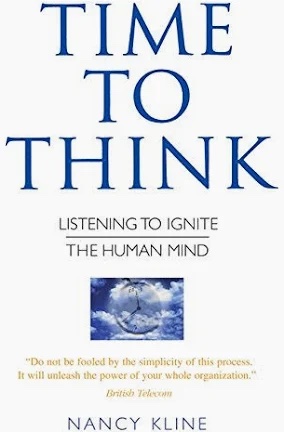
I have recently finished reading Time to Think. Not the (excellent) book by Nancy Kline, which I have read many times; but the newly-published one by Hannah Barnes, subtitled The Inside Story of the Collapse of the Tavistock's Gender Service for Children.

Barnes is an investigative journalist with Newsnight and has interviewed many of the clinicians who worked at the Tavistock, as well as a number of the people who were treated there. It is an extraordinary story.

One thing that caught my attention particularly, right near the end of the book, was the reflection of Will Crouch a highly experienced psychologist and psychotherapist on what had gone wrong, fundamentally, at the Service. He said: 'organisations helping a certain group of people will develop symptoms that are related to the work that they do.' His hypothesis is that exposure to the concrete thinking of the young people that GIDS was trying to help became embedded in the service itself.

I found this fascinating. I have long been aware of what therapists and coaches often refer to as parallel process: that is when the therapist or coach starts to experience emotions that originate with the person they are working with, but feel as though they are their own. This is related, I think, to the idea of confluence, in Gestalt psychology, where we act on someone else's needs or desires, rather than our own. It may spring from a high degree of empathy, and a failure to maintain boundaries, or professional and personal differentiation.

But I had not considered that organisations might be subject to the same tendency.  I mentioned this to a client of mine, and it was like an aha moment for her. Early in her career, she had worked in what was then called a Mental Hospital. And she reflected that it was a mad environment: but very specifically - the organisation had taken on some of the characteristics of its most distressed patients, and they formed a rather dysfunctional organisational culture. 

In the context in which I do most of my work, that is, Higher Education, that raises interesting questions.  Increasing attention is given to the Student Voice: and in many ways, that is clearly valuable.  But this risk suggests that it is also important that the academic body maintains some differentiation, and appropriate boundaries. That, of course, will not be popular, and given the importance of the National Student Survey to Universities' reputations, it will take some courage. But, if I am right, failure to do so will result in Universities becoming increasingly aligned with the more vociferous and extreme elements of their student bodies, and that will not end well, either. 

And I fear that we are already witnessing the start of that trend, when I observe that political stances are placed above academic principles: no platforming, failure to support academics who are harassed for having the wrong views, alignment with partisan advocacy groups, discouragement of unpopular research and so on.

That is one of the reasons that I am so keen on the other Time to Think: the underlying philosophy that we should encourage people to think as themselves and for themselves, and champion diversity of viewpoints and understandings. Higher Education must be the environment in which we can discuss complex issues and explore competing strongly-held views and beliefs. And I hope and pray that Universities will continue to foster that environment.

Friday, 10 June 2022

How do you help others to think outstandingly well?

If your role involves helping, stimulating, supporting, challenging or provoking others to think at their very best, you may be familiar with Nancy Kline's work, published as Time to Think, More Time to Think, and The Promise that Changes Everything.  If you are not, these books are well worth reading and learning from.

At the heart of Nancy's approach, which she calls a Thinking Environment, is the belief that attention is generative; that is, the quality of someone's thinking, in my presence, is at least in part a product of the quality of attention that I give to them. (if you doubt this, consider the reverse: when you are trying to think about something and the person who is meant to be listening is clearly not attending... see what I mean?)

But in addition to a quality of attention that is in fact rare in most work contexts, there are nine other components of Thinking Environment; and there are various applications of these components that are suited to both group and one-to-one contexts.

Foundational is the Thinking Partnership: a precise but easeful approach to enabling someone else to think outstandingly well.  I have blogged previously about this many times, ranging from my initial exploration of the process with Nancy, through to its practical application in a coaching session. (Other posts may be found by clicking the tag Thinking Environment).

So I am delighted to be offering the Thinking Partnership Programme in the Lake District, this autumn and again next spring. This Programme teaches you the Thinking Partnership Session®, a uniquely powerful process for liberating the human mind. Through generative Attention and the building of Incisive Questions, this process produces breakthrough, independent thinking.

If you choose to join us, you will participate both as Thinker (considering topics of your choice), and as Thinking Partner (practicing this elegant expertise). Along the way you will explore all Ten Components of a Thinking Environment.

This course is a prerequisite for the Coach Qualifying Course, should you wish to take your practice to the next level.

More details are on my website, here; and of course if you wish to talk about the programme, or have any questions, I'd be delighted to hear from you.


Thursday, 31 March 2022

Is Understanding Over-Rated?

Regular readers of my musings will know that I am a big fan of Nancy Kline and her work (see my numerous posts on my blog with her name as a tag...).

More recently, I have also become a fan of Kathryn Mannix (only three posts mentioning her, prior to this one, but as I say, I am a recent fan).  Her latest book is Listen: How to Find the Words for Tender Conversations. For those interested, I have reviewed this briefly on the Coaching Supervision Partnership blog, here. It is an excellent read.

There is, of course, a lot of congruence between what they both write about listening, which is hardly surprising. But I was also struck by some stark differences, or even contradictions.  In Nancy Kline's world, it is not important that the listener should understand the thinker. In her books, she gives examples of times when she has not understood, and  that has not, finally mattered.  Whereas interrupting to clarify or check understanding would, in her view, have interrupted the thinker's waves of thinking, and would therefore have been unhelpful. 

I have blogged previously about listening to somebody thinking in a language that I do not speak, and how valuable the person I was listening to found that experience.

However, Kathryn Mannix sees understanding, and communicating understanding, as incredibly important. The fourth chapter of her book is called Listening to Understand.  She writes: These occasional interruptions to check understanding don't usually put the speaker off. In fact, they help the speaker to feel properly listened to. This feels almost like heresy to someone steeped in Kline's approach (though very conventional in terms of most teaching about active listening). For Kline, interruption is the big problem: that is why her latest book is called: The Promise that Changes Everything: I Won't Interrupt You.

So what do I make of this? I have already said that I am a fan of both: I find both of them inspiring and wise guides, who have taught me much. Is one right and the other wrong? And if so, which is which?

But in fact, I think both may be right; and that the difference springs from the contexts in which they are thinking of listening, and the purpose of such listening.  

Nancy Kline is very clear that the singular purpose of her Thinking Environment approach is to help the other person to do their very best independent thinking: to think as herself and for herself. In that context, my understanding may not be necessary (or even helpful, as I noted in my post linked to above, about someone thinking with me in Hindi). For here we are concerned with the thinker's individual cognitive journey, and we do not wish to interrupt that.

Whereas Kathryn Mannix is concerned about listening when a tender conversation is needed: when there is a hurt to be tended. This is primarily the realm of emotion; and in that realm, in order for someone to process their emotions and for the listener to be able to respond with appropriate tenderness, it may well be important for them to feel truly understood by the listener. 

That is not to say that Kline's model doesn't allow for emotional exploration (it does) nor that Mannix's doesn't expect intellectual engagement (it does); but I do think that both the context, and the purpose, of these conversations may change our sense of what is most helpful, as listeners.

All of which brings me back to a question that one of my supervisors once told me was the most important question in any one-to-one work: what are these two people doing together? If we can answer that (ideally together - which is a large part of what I call contracting and re-contracting) we should have greater clarity about what listening processes will best serve us.

Friday, 25 June 2021

How does that help?

 How does that help? I was asked.  And it's a good question.  The that under discussion was being supported to think out loud - all that Nancy Kline stuff I keep going on about. And the challenge implicit in the question (which I elicited by listening...) was that if you simply say out loud what you are already thinking, that doesn't take your thinking any further forward.


David Rock, in his book The Brain at Work, which I have already blogged about, highlights our intuition that saying difficult stuff out loud is more likely to be unhelpful: solidifying the difficult stuff as something real (our intuition often tells us the same about writing it down, come to that - and we'll return to journalling in another post, another time). Yet, he says, the research suggests that the reverse is true; or at least, that it can be very helpful.

And that is my experience, too, both with regards to sharing my own difficult stuff, and hearing other peoples'. Why might that be?

I think that there are several reasons. Jordan Peterson, in 12 Rules for Life, talks about how helpful it is for the brain to be required to order and select, from the myriad bits of detail and noise surrounding an experience, those which we regard as important; and telling our story out loud makes us do that. That has a clarifying effect: rather than all the undifferentiated noise, we now have a narrative that we can examine.

And I am reminded, too, of Dumbledore's pensieve: a device into which he could place his thoughts and memories, to be examined, but also (presumably) to free up cognitive processing capacity in his brain. 

In my experience, there are a few other things that go on.  When one is listened to really well, one takes one's thinking further: it is not uncommon both for me and for those I am coaching, to surprise ourselves with what we say; and then to pause and wonder Do I really think that? Sometimes we expose our own inner hyperbole, our love of drama, our need to be the hero - or the victim. And once it is said out loud, that is easier to recognise and address.

Also, thinking out loud is often a good way to address rumination - that rather less helpful process of going over and over worries without progress or resolution. Somehow, the presence of a listener makes rumination seem too self-indulgent, and we tend to move forwards, rather than just round and round, in our thinking. 

There are also benefits in the very process of assigning words to our thoughts. Worries can be vague and all-encompassing; but naming them both makes them more specific, and therefore more limited.  Moreover, the very act of naming something gives us a feeling of power over it.  Children learning to deal with disruptive emotions are often told Name it to tame it! and that is very good advice. That, of course, relates to the naming of stories that is part of my Shifting Stories methodology.

I realise that I have written here particularly about the value of thinking about difficult stuff in this way; but I think this also applies to thinking about positive stuff.  Indeed, I would argue that there is a particular value in doing so. We often pass over the positive too quickly, for many reasons. One is that thinking about it with someone else may feel boastful or arrogant; another is that it doesn't need our attention in the same way - there is no problem to solve; and so on.  However, there are real benefits to reflecting on what has gone well, both for our mental well-being, and for our learning. 

So I will end with that challenge to you: find someone who is prepared to listen to you with exquisite attention, and then spend a few minutes (10?... 20?...  30, even?...) really unpacking some success that you have had to see what learning, and affirmation, there is for you in it.  And then, of course, do the same for the person who has been listening to you: and you will realise that neither role is a waste of time, nor dull, nor any of those other excuses our mind presents to us when we consider such an activity.

Friday, 19 March 2021

Emotional Intelligence and the Thinking Environment

I blogged recently about David Rock's SCARF model (which is one approach to Emotional Intelligence) and its links to Nancy Kline's Thinking Environment. In this post, I consider the Genos EI model  (about which I have also blogged previously) and its relationship to the Thinking Environment (about which I have blogged very frequently!)

The first of the six EI competencies (in the Genos model) is self awareness. It is fairly clear how a leader who is being coached in a Thinking Environment style, which involves ever deeper reflection and the questioning of assumptions, is likely to develop better self awareness. Not least, as one of the questions repeatedly asked in a Thinking Environment is 'What more do you think, or feel, or want to say?' That invitation to consider feelings as valid and important parts of the leader's data is both simple and powerful. Unacknowledged and unexpressed emotions are not only blocks to good thinking, they are also often significant blindspots. Bringing them into the conversation certainly enhances self awareness on many occasions.

However, it is less obvious that such coaching will support enhanced awareness of others (the second competency). It may do, of course, but equally, it may not.  And the same seems to apply when considering the other four competencies: authenticity, emotional reasoning, self management and positive influence.  Each of those may be developed in a Thinking Environment coaching relationship; but there is no guarantee that is the case.

I was thinking about this in a Thinking Partnership conversation with a colleague, and had got this far. So I was starting to conclude that the links between the Thinking Environment and Emotional Intelligence were rather less obvious and more tenuous than I intuitively imagined. Fortunately, I asked my colleague for her views as I got to the end of my thinking. She pointed out that I was thinking about only one way in which the Thinking Environment might apply.

If one considers leaders who are not only the beneficiaries of a Thinking Environment for their coaching, but also start to be practitioners, applying the principles and practice in their workplace, the picture changes dramatically.

Leaders who genuinely listen to others and help them to develop their thinking are certainly likely to enhance their awareness of others and their positive influence. The practice, if taken seriously, includes striving to embody all ten components of the Thinking Environment.  That certainly requires and develops self management: not least the need to refrain from interrupting. And such leaders, genuinely listening to others individually and in teams, is likely to become much better at emotional reasoning: that is, factoring in all those human dynamics when considering different possible courses of action. And I think the practice of self awareness and self management, informed by that enhanced awareness of others and emotional reasoning, is likely to develop a more genuine authenticity in Leaders. I think that last may be the weakest link, but I think it's a reasonable hypothesis.

So all in all, I think my intuition was well-founded: there is a strong link between Kline's Thinking Environment and Emotional Intelligence: it was merely my initial framing of my exploration that threw me off the track for a while.  I will, of course, continue to think about this (both on my own and with colleagues) and may post further musings in due course.

--

With thanks to Kelly Sikkema for sharing her photography on Unsplash

Monday, 20 July 2020

From the Other End...

I have blogged a few times about the work of Nancy Kline and her Thinking Environment; and how the quality of listening that she champions helps people who are listened to in that way to think at their very best.

But what I think has been neglected (or at least, I have seen and heard little about this) is the effect of listening in that way on the listener. So in this post, I consider the Thinking Environment - listening in that way - from the other end, as it were.

By 'listening in that way,' I mean embodying the ten components of a Thinking Environment: Attention, Ease, Equality, Difference, Appreciation, Information, Encouragement, Feelings, Incisive Questions and Place. See my post here for my earlier discussion of these.


My hypothesis is that, over time, the practice of listening in this way instils habits in the listener that become part of his or her character; and I am mindful here of Aristotle's view of virtues being habits of good behaviour.

My idea, therefore, is that these ten components are helping me (and others who follow this discipline, of course) to acquire and integrate certain good habits into our repertoire, and this blog post, as usual, is my thinking out loud, as it were, about this idea.

So what virtues do I think that it fosters? 

In the first place, generosity: the gift of full attention, laying aside one's own interests and concerns for a while and creating that sense of ease which is essential to this work, as well as making the effort to overcome our embarrassment and offer genuine appreciation of the other person, are all generous acts.

Linked to that, but separate, is an appropriate humility.  The component of equality reins in our ego, and any tendency that we may have to assume that we know best. And that is not merely an intellectual posture: the actual practice of listening in this way is often humbling. As people reveal their thinking I am frequently in awe of their qualities, not just in terms of the solutions they discover to the issues they are addressing, but also the values they bring to bear: vulnerability, compassion, tenacity and many others are frequently displayed.  Interestingly, that same component of equality helps us to guard against a false self-deprecation: whilst we are to see ourselves as no better than the other person, we are also to see ourselves as no worse; and for some of us, that is a healthy restorative.

And linked to humility is something about genuine interest in other people and their perspectives that will tend towards wisdom. The component of difference is relevant here: valuing other people's perspectives and seeking to learn from them, rather than simply discount them or over-ride them with our own. This is one path to learning, of course...

Finally, I think the practice of listening like this can lead to increased self-insight. In particular, that can arise from the openness to difference, already discussed, and also from the questioning of assumptions that underpins the formulation of Incisive Questions. The constant quest for assumptions that others make, and our critical engagement with them increases our ability to recognise our own.

Therefore, I continue to work in this way, where appropriate, not only because of the utilitarian reason, that it seems to work for my clients; but also because of the personal development imperative: it is helping me to become more the kind of person I aspire to be (from which my more perceptive readers will realise that I see myself as someone who needs to increase his generosity, humility, wisdom, and self-insight - not an unworthy project for the next few years).

--


With thanks to Mimi Thian, Iqx Azmi, Jordan McDonald and Markel Hall  for sharing their photography via Unsplash.

Friday, 5 June 2020

CPD during my Sabbatical...

One of the ways in which I am using my self-declared sabbatical is investing time in my own development. That includes a Leadership Team Coaching Programme, with Peter Hawkins and David Clutterbuck, a further Time to Think programme, with Laura Williams, and a Transformational Narrative Coaching programme, with Nick Isbister. And in addition to all that, I have also been working to improve my understanding of Trauma, in support of another project I am involved in.

All of these, of course, build on existing areas of interest and are intended to help me to work to an even higher standard with my clients.

The Leadership Team Coaching programme is proving very interesting. Hawkins and Clutterbuck are major figures in the coaching world, and have a wealth of experience as well as knowledge to share. Whilst the format (600+ people on a 90' webinar) was initially hard work, they have responded well to feedback and made the third (and most recent session) very much better. These webinars are supported by smaller online practicum sessions, as well as handout material etc.  I've also agreed to meet a colleague, who is also going through the programme, after each webinar to share insights and challenge each other to find ways to apply the learning, which has really helped to bring it alive.

People who know me will understand the appeal of doing a further Time to Think programme. Nancy Kline's Thinking Environment has proved very valuable in improving my practice over the last few years. So far, the training programmes I have attended with Nancy and with Shirley Wardell have focused very much on the one-to-one applications of the Thinking Environment. This programme, the Foundation Course, focuses on group applications, and is the precursor to the Facilitation Course, which I intend to do next. It will be particularly interesting to do this programme online, as that poses particular challenges to the Thinking Environment approach, particularly as it applies to groups. But, of course, at present, pushing the boundaries of what we can do remotely is particularly important, and I am confident that I will learn a lot from Laura, another expert in the field.

The appeal of Nick Isbister's programme should be equally clear. My own interest in narrative approaches goes back many years - Shifting Stories was in gestation (and procrastination) for many years before I published it in 2016. So when I found out that Nick was doing something similar but distinctively different, I was naturally intrigued.  So I bought his book, and booked a call. We had a fascinating chat, and I booked on to his programme. It's early days yet (I've only completed the first part of the programme, which has been very much about taking stock of my story (or stories) so far, and what I make of myself, as Actor, Agent and Author. But it has already proved a very rich and thought-provoking process, and I am looking forward to crafting my future story with Nick's help. Given how much the world is changing at the moment, this seems a particularly appropriate time to be investing in such thinking.

With regard to trauma, I have been reading Gordon Turnbull's account of his career: discovering the reality of post traumatic stress, and then pioneering approaches to help people to address it. I have also been reading some slightly more technical and academic books on the subject, recommended by colleagues. For me, this is not about developing the skills to work with those suffering from trauma - that would be crossing the line from coaching into therapy - but rather to understand better what the indicators are, so that I can make appropriate referrals, and be clearer about that boundary; and to support me in my work as a coaching supervisor, so that I can help the coaches I supervise to be equally clear about those boundaries and the limits of their appropriate support.

Thursday, 2 April 2020

That "What more" question...

Yesterday, I ran a series of virtual workshops, for people who are going to be mentors in the Inclusion Matters - Northern Power research project. One of the things we practiced was using Nancy Kline's Thinking Environment principles as part of the mentoring skill set.

As participants included successful academics and senior business leaders, we had some interesting reflections on all aspects of the training.

One was on the power of the question: what more do you think, or feel, or want to say? which is core to Nancy's approach. It is used when someone has said all they can think of in answer to an initial open question and is beautifully designed. It is completely open and non-leading, allowing the person being listened to follow his or her thinking wherever it wants to go.

It is clearly a much better question than the one people find it easier to ask (I picked up on this with a few yesterday): is there anything else...? For that risks communicating that enough is enough, and also makes it easy for the person to say no; whereas the What more...? question suggests that more is expected and will be welcomed - and also prompts (I nearly said, forces) the thinker to consider... well to consider what more?...

All that I had known, but participants' reflections yesterday took my understanding further. The initial answer was often what they knew they thought about the topic - and therefore did not give them any real insight, interesting though it may have been to the listener.  But answering the What more...? question prompted them to think out loud in live time, and their answers were often clarifying, sometimes revelatory, and occasionally surprising to themselves. People mentioned how it led to a higher order of thinking, how it took them deeper very quickly, and how, despite both its apparent artificiality (especially when repeated several times) and its simplicity, it was a hugely powerful and catalytic question.

It was the single issue in the training that was most frequently commented on by participants as being particularly helpful and something they will resolve to take forward into their mentoring, and more broadly into their practice as leaders, academics and teachers.

And on a personal note, having, as I do, my own share of Imposter Syndrome, I found it was reassuring to hear from some very skilled and experienced senior academics and business leaders that they had learned valuable things about mentoring, when they have already been taught how to do it, and how to listen and so forth, many times over their careers. So a veritable win:win - I learned something of real value, and so did they!

Thursday, 12 March 2020

Empathy

One of my coaching clients was asking about empathy, the other day. Which set me thinking... and one of the things I thought was that Gerry Egan is bound to have wise words on this, and likewise Carl Rogers.  Which set me reading...

Egan, as ever, is very good. His book, is a foundational text for all those in the helping professions, and has a couple of chapters on empathy.

In the first he focuses on reflecting and checking what you have heard as the core of the other person’s communication; a typical structure would be: ‘you feel…. because….’ in a tone of voice that suggests enquiry rather than judgement.  That is designed both to demonstrate that you have been listening and are trying to understand (in particular) the emotional weight of the communication; and also to invite the other person to amplify, modify (or if necessary correct) the impression that you are forming. It is also an invitation to the other person to talk further - a signal that this is discussable stuff and that you are open to that discussion.

In a later chapter, he discusses ‘advanced empathy’ and specifically:
  • Helping clients to make the implied explicit
  • Helping clients to identify themes
  • Helping clients to make connections
  • Helper self-disclosure
These are all valuable approaches, of course, and regular tools in the coach's kitbag. But it useful to have them listed in that way, and to do a mental audit of how frequently, and how well, one uses them.

Rogers, in Client Centred Therapy, focuses more on the tonality of the exchange: how important it is that the way in which the helper (coach, in my case, though therapist in his language) is heard by the client to be on the client's wavelength; and above all not judging the client.

And then, by one of those leaps of insight that mark me out as a man of exceptional something or other (one client referred to my interventions as a 'blinding flash of the obvious,' which I take as a compliment...) I reflected on how much Nancy Kline's work (in which I am particularly interested) serves to create the conditions for empathy.  Indeed one might say that her ten components of a Thinking Environment offer an excellent blueprint for creating the conditions for empathy.

The ten components are: Attention, Ease, Equality, Diversity, Appreciation, Information, Encouragement, Feelings, Incisive Questions and Place. 

So these three perspectives, I think, offer a very useful way of triangulating our thinking and self-reflection on empathy. As ever, I am indebted to my coaching clients for provoking my learning: mine is a truly privileged job!

Sunday, 12 January 2020

Feelings

In my last blog post, before Christmas, I wrote about the importance of place, one of the ten components of Nancy Kline's Thinking Environment.  

In this post, quite by coincidence, I am writing about another component, Feelings. (This may turn into a series: having found I have something new [I think] to say about these two components may lead me to consider what I have to say about the others - but I digress).

The coincidence that leads me to write about Feelings is that I came across a powerful passage in Kathryn Mannix's book, With the End in Mind.  I was given this powerful book, which seeks to encourage people to talk about death more, and more openly, for Christmas; and I have already written about it on the Shifting Stories blog. Kathryn Mannix writes on this topic based on her many years of experience as a medic doing pioneering work in palliative care with the dying. But what made me think about the Feelings component of the Thinking Environment?

In a chapter called Beauty and the Beast, Mannix tells the story of a young mother who is dying of cancer. After sitting with her patient through an extremely emotional outpouring (the first this young woman has allowed herself) Mannix says:

Kathryn Mannix

She gulps and takes a deep breath, but she is now so busy thinking about her thoughts that she is no longer awash with emotion. Here is an important truth in action: by being able to sit with the deepest anguish and not shut it down, it is possible to enable people to explore their most distressing thoughts, process them, and even find more helpful ways to deal with them.’

That is precisely the reason that Nancy has included Feelings as one of the components of the Thinking Environment: unexpressed feelings inhibit good thinking; and by enabling and allowing someone to express their strong emotions, and for that to be all right, we can help them to move on to do more excellent thinking. I was already fairly sure that this was accurate,  both from Nancy's reasoning and from my own experience, so it was fascinating to have that confirmed by someone highly experienced in working with people at times of intense emotion in a very different field.

Incidentally, Mannix's book is well worth reading for many other reasons, which are, perhaps, best summed up by the sub-title Dying, Death and Wisdom in an Age of Denial. There is a link to her BBC talk about 'Dying is not a bad as you think' on the Shifting Stories blog.

Monday, 25 February 2019

Supervision in the Thinking Environment

Those who follow this blog assiduously (yes, both of you!) will know that I am a fan of Nancy Kline's work on the Thinking Environment; and also that I have raised questions about it, and in particular the risk of collusion inherent in all person-centred approaches. (I have also blogged about how that risk is mitigated in coaching, here).

At a recent meeting of Nancy's Collegiate in London, I learned that Eve Turner, a member of the Collegiate, had just published a book, The Heart of Coaching Supervision, which contains a chapter on Supervision in a Thinking Environment.

So of course, I rushed out and bought the book (when I say 'out' I speak metaphorically: I bought it on the web...). And very good it is, too.

And today, I tried my first supervision using Eve's Thinking Environment Supervision model. It works something like this:


Part 1

Supervisor: With regard to your (focus) practice, what would you like to think about, and what are your thoughts?

What more do you think or feel or want to say? (and repeat...)


Part 2

Supervisor: What question(s) do you have of me?


Part 3

Coach: What observation, question or input do you have for me that we have not already covered?


Part 4

Coach’s final comments/reflections

Both: what quality do we admire in the other?

I found this very easy to use: it fits in intuitively with my work as a Thinking Environment coach. More importantly, the coach I was supervising found it very powerful: she generated significant learning for herself about a very difficult question she had bought to supervision; some of that in Part 1, where she was allowed to think for as long as she wanted, in ease (as we walked above Ullswater, as it happens); and then encouraged to think for a little longer still.  And some of it in response to the answers I provided to her questions in Part 2, and a reflection I shared in Part 3.

And it clearly addresses the earlier concern I had about collusion (which of course is particularly important in the context of supervision) by requiring the supervisor both to answer questions the coach may have, and also to provide any additional 'observation, question or input' that has not already been covered. That places an obligation on the supervisor to be sufficiently skilled to address (for example) all the issues raised by Hawkins' 7-eyed model, or all the considerations of Murdoch and Arnold's Full Spectrum Supervision.

So a very fruitful afternoon, both for the coach and for me as I continue to learn about supervision - and given I have just started on my post-Graduate Diploma in Supervision, that is just as well!