Friday, 27 November 2015

Coaching Supervision

Last Friday, Cumbria Coaching Network's meeting was a session on Coaching Supervision, led by Trish Brady.  Trish led a discussion of the what, why and how of coaching supervision, and then demonstrated a supervisory session, with a volunteer coach, using Hawkins' 7-eyed model.

She also invited us to contribute appropriate questions for the different levels, many of which were extremely helpful in provoking new insights for the coach.

Then on Tuesday, I facilitated a meeting of the external coaches that Newcastle University uses, and as part of that invited the coaches present to share what they had learned relevant to coaching practice, over the last year or so. 

I was struck by how many mentioned the value of supervision. That in itself should not be surprising, of course, as one of the purposes of coaching supervision is to ensure that the coach continues to learn through his or her practice.  But a number of people cited the value of having more than one supervisor, or of having both a single supervisor and attending a group of co-supervisors. 

That closely reflected my own experience over this last year. I have a long term coaching supervisor, the excellent Ann Bowen-Jones, who is both a psychologist and a great coach, and who has helped me learn a huge amount over the years - and continues to do so. 

But this year I have added to that. I have joined a coaching supervision group, in which alternate meetings are co-supervision, and for the ones in-between we invite Keri Phillips to supervise. These have taken my understanding in new directions: the different interests and experiences of the group members regularly surprise me and open up new perspectives.  And more recently, I have established a co-supervision arrangement with Jan Allon-Smith,  as a way for both of us both to improve our coaching practice, but also deliberately learn more about the process of supervision: and again Hawkins and Shohet's work is one of the frameworks we use for that.

All of this has been hugely beneficial in terms of broadening and accelerating my development as a coach; so the upshot of this is simply a reflection for myself, and a piece of advice to other professional coaches, on the high value of multiple supervisory perspectives.

Friday, 20 November 2015

The Story of the Unfinished Business...

At a supervision meeting of volunteers I work with, the issue of Unfinished Business was raised. One of the least satisfying parts of our work is that we often never hear the end of our clients' stories. When they are no longer in crisis and no longer need support, our involvement can end. That can be very unsatisfying, and sometimes unsettling: we know we left them on an upwards trajectory, but rarely is everything sorted and perfect.

That issue of unfinished business reminded me of a story a friend told me over dinner a week or so previously. He had suffered from adult-onset epilepsy. The medication he was given had an unfortunate side-effect. He started to suffer from troubling flashbacks/daydreams. These were all of a similar nature. He would remember some past encounter, of a trivial nature, with someone whom he had only met once, when the encounter had ended unsatisfactorily from his point of view. Many of these dated back years, and he had not consciously thought about them since.

One example was a time he had been stopped by traffic police and one of them had been unnecessarily sarcastic, some twenty years ago. But what troubled him was that each flashback ended with an imagined scene in which he beat up the other person. Needless to say, he is not given to violence, nor even to violent fantasies. So he found these flashbacks/daydreams very troubling, and at one stage was having several a day.

He went for a couple of counselling sessions, and his counsellor suggested a very simple idea. He should re-visit each of these encounters in his mind, and re-write the story by imagining an ending with which he would have been satisfied. So in the case of the police, for example, he imagined that he had had a word with the non-sarcastic police officer about the other's behaviour. He further imagined that the non-sarcastic officer had returned to the patrol car and given his colleague some uncompromising feedback about his sarcastic behaviour.

As he was telling me this part of the story his wife chipped in, to say that she had been extremely sceptical of this idea when he returned from that counselling session. It sounded too easy, too simple, to be effective. Yet effective it was!

From the moment he imagined a better ending to each of these stories, which I suppose must have been lurking unresolved deep in his unconscious mind for years, the flashbacks stopped. 

Just when I thought I had completed my book on Story, too...

Saturday, 14 November 2015

Singing to Break the Ice

I was intrigued to read the research from Oxford about singing as the most effective way to break the ice with groups.

I read this just as I was starting running a Leadership Programme with the VC at Winchester University, for 20 or so academics and professional services staff. 

So it seemed a good idea to apply the research. The question was, what to get them to sing.  I decided on monophonic (rather than say, barbershop!) music, as I wanted to work within my own limitations, and did not want to spend too long on the exercise.

But I also wanted something that would be challenging, new to them, and relevant. As it was just before Remembrance Sunday, and also because it is music I know well, I decided on the Introit from the Gregorian Chant Requiem. 

It felt a little risky, but I explained to them why we were doing it (ie I'd just read some research) and then taught them the first phrase, word by word. I displayed the music on a screen (and much help that was, I am sure). They entered into it with a will, and one of them made a point of telling me later that she and others with whom she had talked had really liked the exercise.

Encouraged by that feedback, I did the same thing with a similar group in Cardiff, again with the VC obliged to sing along, on Remembrance Day itself. This time, the exercise was greeted by applause. 

To be honest, I wondered if the applause was at least in part an emotional discharge, as I know some people find the requirement to sing in public embarrassing. So I will read the written (and anonymous if desired) feedback from both groups with particular interest. And if it does mention the icebreaker, I will report back here.

In the meantime, this is how it should sound: from a concert I organised a decade or more back with the Schola Cantorum (School of Chant) with which I used to sing in Newcastle.


For the record, it was a wonderful concert. Eric Cross's choir joined us, and sang the Duruflé Requiem, which is clearly based on the Gregorian Chant melodies, with modern French harmonisation. And the way we programmed it, was to put the movements side by side: so we sang the chant Introit, then the choir sand the Duruflé Introit, and so on.

So here is the Duruflé Introit (and the rest of his Requiem, come to that), for old times' sake.


Friday, 13 November 2015

Emotions, Thoughts and Meditation

I am a fan of Goleman's work on Emotional Intelligence, and particularly as applied to Leadership (see The New Leaders).

One of the many reasons it appeals to me, is that it starts with the self. Rather than describe what a leader should do or say to others, in order to lead, it starts with the leader increasing his or her self-awareness: noticing, and then learning to regulate, what is going on for oneself emotionally.

However, recently I was talking with a leader I know. He is, I think, a good leader and manages his emotions effectively most of the time, which also enables him to lead others well, in the way Goleman et al suggest. However, he was telling me of a recent occasion when he 'lost his rag' in a senior meeting.  

The occasion was relatively trivial: and indeed that was what infuriated him. Senior people seemed to him to be squabbling about something of little or no consequence. It was silly and it was a waste of time, in a meeting when there was much serious work to be done.

All of which prompted me to think that it is not sufficient to notice and regulate one's emotional responses, important though that may be. Under pressure (or for other less obvious reasons, in this case probably a combination of overwork, exhaustion and exasperation) the emotions may leak out and one may lose one's rag.

So there is a prior discipline: of considering how we are making sense of the world, and doing so in a way that does not lead to us having to manage sudden emotional responses. There are many approaches to this, including CBT based approaches, for example, and my work on Story (did I mention, I have finished the book - there is just a little editing to be done now...?). So as well as the emotional component, we have to attend to the rational. But the other component, I think, is the spiritual: the cultivation of serenity, through a spiritual discipline to match the intellectual and emotional disciplines. 

That, I think, is what meditation has to offer, and why it is being rediscovered as an important part of the repertoire for those seeking to be truly effective. I have blogged before about my own developing discipline, here. I was reminded of the impact that this practice is having once again, when a couple of fairly major issues popped out of the woodwork, and I found that I was not only able to cope with them calmly, but also to feel calm throughout - which meant there was no danger of inadvertent leakage of inner turmoil.

Meditation is one of those things for which we feel we never have time: after all, it feels as though we are doing nothing - a terrible waste of time! But increasingly, I am convinced that investing time in meditating (a little, regularly) is saving me huge amounts of both time and energy.

Wednesday, 28 October 2015

Diversity Training

I have been reflecting on Diversity and Diversity Training recently. As usual, this post is my thinking aloud on the subject. In particular, I am no expert on this one, and am interested if others think I am on the wrong track here.

A while back, I was running some change workshops for a large organisation, for a number of teams who were facing a serious and unwanted change.

As we planned them, the responsible senior manager mentioned that we would also have to include some diversity training, as it was that organisation's policy that all their training should include diversity training (I understand that there was some history behind that policy, of the organisation falling foul of discrimination legislation).

I was clear that I am not particularly well-informed on the subject: my idea of diversity training would be that we should be nice to everyone, whether we agree with, or approve of, them or not.

However, we realised that we needed to do something a little more substantial, and so the corporate diversity champion was invited to contribute. He agreed to do a half hour slot on each of the workshops.

He was a charming gay man, who entertained the group by starting his session singing an operatic aria: he had a fine tenor voice. He then told us a little of his history as a gay man in a world that was often prejudiced against gay men. He told us how hurtful it was when social workers had questioned him about his relationship, when he was seeking to adopt children. He ended with a plea that we should all campaign for equal marriage (this was before the legislation).

Afterwards, the senior manager with whom I was working said that she had wanted to ask some questions, but had known that she could not. Her concern was that they could have been interpreted by him or by others present as homophobic, and that would have been the end of her career.

I was reminded of all this when reading some of the debates surrounding Caitlyn Jenner, formerly Bruce Jenner, who has just been awarded Woman of the Year status by some magazine; and Germaine Greer's view that a man who decides he is a woman does not, thereby, become a woman. 

The odium heaped on Greer by some was extraordinary. She did not, so far as I could see, wish any ill on Jenner, or wish to deny him anything; she merely disagreed intellectually with him. And that gave me pause for thought. 

And what I thought was this:

Surely diversity cannot mean that we must all agree with everyone about everything; it must mean that we cultivate the ability to work positively and compassionately with those with whom we disagree.

I liked the gay man who was the corporate diversity champion, and it is no fault of his if questioning any of his assertions is too risky for a senior manager. I sympathise with Caitlyn Jenner: I cannot imagine what he has gone through, but can well believe it to have been very difficult.  

However, what both these people, and much of the diversity industry, seem to me to want is not just sympathy and understanding, but approval and unquestioning agreement with their worldview.

When one has been oppressed and hurt, I can see how easy it is to conflate disagreement and dislike: but in fact they are not the same thing.

And when it comes to diversity training: it seems to me that it is all too often promoting homogeneity of view rather than debating and, dare I say it respecting, diversity of view.

The pinch point comes when you get students at a University who are so wound up by this, that they wish to make the University a 'safe space' - a space into which views that they do not like cannot intrude. That seems to me to be the antithesis of a University, and I was glad to see the Vice Chancellor at Cardiff tread that difficult line of robustly defending free speech, whilst also positively affirming the University's commitment to equality and diversity.

Saturday, 24 October 2015

What do I think I am doing?

I was struck, reading Brown and Brown's Neuropsychology for Coaches, by this:
By effective coaching from a brain-based perspective, we mean: The capacity of a professional coach to so understand and manage the brain processes of the person who is being coached that effective change and development within the person, plus the consolidation of change and development, is deliberately created and consolidated for that person’s benefit, bounded by what has been agreed contractually between the two people involved. 
I love the clarity of that, but is that what I really believe I am doing, when I am coaching?

And if it is, how do I do it?  

Historically, I have described my coaching to new clients like this:


Confidentiality is guaranteed, but there are boundaries to the confidentiality contract:

1 If the coaching is being paid for by someone other than the individual, then objectives may need to be agreed with the sponsoring organisation (typically the employer) - which will clearly reflect part of our initial conversation. I will always agree these with you before sending anything to your employer. That will also normally include the number and the duration of meetings, and an indication of when the coaching is completed. There is no other feedback from me to the employer.

2 I discuss my coaching work with my coaching supervisors, but do not identify individuals.

3 If you reveal that you are working against the best interests of the sponsoring organisation (typically the employer), or breaking the law of the land, then I will suggest that you stop, and tell someone as appropriate. If not, I may have to tell someone - and will inform you of that.

The mechanics of the process

When we work together the agenda is set by you: we will work together on issues that are chosen by, and important to, you.

Meetings are typically 90 minutes long, face-to-face, by Skype or phone; at a frequency to suit you (typically around every 4 - 6 weeks).

In between sessions, you will have work to do: the actions (which may include reflection, reading, as well as doing)  you have chosen as a result of the coaching conversation


What you can expect of me as a coach

I see my role firstly as to help you to see more options than you are currently seeing, both in terms of the understanding you are making of reality, and in particularly in terms of possible actions.

I may do that in any one of a number of ways. It may be simply by listening and questioning, to take your thinking to new places. It may be by bringing some relevant theory or knowledge to bear. It may be by sharing experiences of working with others on similar issues. It may be by using my own intuition. However, the intention is always to develop more options.

A second aspect of my role is to encourage you to take action. So towards the end of each coaching session I will ask: ‘So what are you actually going to do as a result of this conversation?’ Action often includes thinking tasks as well as activity in the more usual sense of the word.

A third aspect is to act as an external conscience: to help you to hold to your good intentions. So before the start of second and subsequent meetings, I ask you to send me a Success Report: a pro forma that invites you to reflect on what actions you committed to, what you actually did, what you learned, and what your priorities are for the next conversation. 

A fourth aspect of my role is to help you to reflect and to learn from experience. Therefore we start the second and every subsequent conversation by reviewing actions and learning arising.

At the end of the agreed programme of coaching, I encourage you to reflect on learning over the whole process, and to plan to sustain it beyond the end of the coaching relationship. I also invite feedback on the process, both in that final meeting, and subsequently via an online questionnaire some 3 months later. We may also agree a 6- or 12-month followup.

What I expect of you

I expect you to discuss the issues we are addressing openly and honestly.

I expect you to take the actions you have chosen at the end of each session, to reflect on them, and to report them back to me via the Success Report.

I invite, expect and welcome feedback throughout the coaching process.

What we might work on

People bring a huge range of issues to their coaching conversations. Some that come up frequently include:

Assertiveness
Career development
Confidence
Conflict
Coping with unwanted change/unexpected setbacks
Delegation
Emotional intelligence
Fire fighting and long-term goal achievement
Leadership 
Managing upwards
Organisational politics
Performance management
Personal resilience
Presentations
Strategic thinking
Stress 
Time management
Work/life balance
Writing

… and so on. 

--


What I am now considering, is whether that is still an accurate and sufficient description. It is based on a practice that focuses on skilled listening as a major factor in effective change (cf Carl Rogers, Nancy Kline etc) and also on Kolb's learning cycle. 

But it says nothing about the psychological and spiritual understandings that increasingly underpin my work. 

As I study, work with other coaches, learn from my reading and my supervision sessions, I have a growing awareness of all of these, and they inform my practice: but finding words to describe them is difficult. I don't want to talk too much about the therapeutic understandings both because I am not a trained therapist, nor do I want people to be put off coaching because they don't want therapy.

Likewise, I am wary of talking too much about the spiritual dimension, at least until people know me a little, as that is so open to so much misunderstanding, that I fear that any discussion of it may mislead more than it enlightens.

Yet, I want to be authentic and open with my coaching clients: indeed, I think that is essential for a good coaching relationship.

So over the next few weeks and months, I will be continuing to work on this: and if I get anywhere, I will certainly blog about it.

And as ever, I welcome thoughts and ideas from others, whether publicly (in the comments here, for example) or privately in conversation or by email.

Friday, 16 October 2015

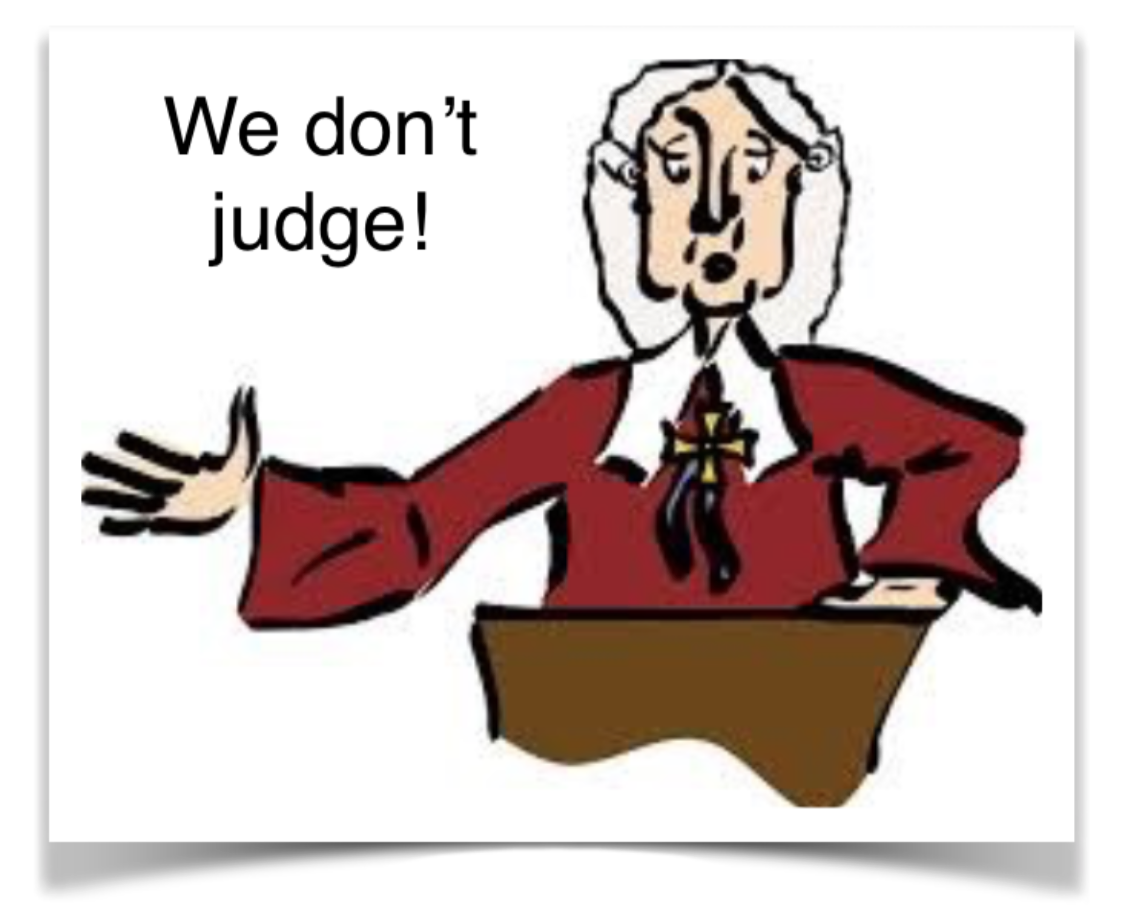
Non-Judgemental Coaching

I have been reflecting on Non-Judgemental Coaching, and this post is really my thinking aloud on the topic.

On the face of it, being non-judgemental seems a good stance for a coach to take, and it is often taken as a given for good coaching practice. See here, and here for a couple of fairly typical examples. 

But the more I think of this, the less that simple stance makes sense.

On the one hand, of course nobody wants to be judged, and further, as a coach, one tries to work with the client's material, including his or her judgement.

However, even in the first article cited above, the author writes:   It is, however, a truism that it is necessary and useful to challenge universal truths the Client holds if these are limiting or otherwise damaging to the process of self-change and realisation. Building the coaching relationship is a dynamic process which nurtures honesty, trust, reliability and curiosity.

Clearly, such challenges are based on a judgement, made by the coach, that 'these are limiting or otherwise damaging to the process of self-change and realisation.' So how can one call such an approach non-judgemental?

Likewise, to say that 'Building the coaching relationship is a dynamic process which nurtures honesty, trust, reliability and curiosity,' is to bring a lot of judgements to bear: not least, judgements about the desirability of 'honesty, trust, reliability and curiosity.'

Moreover, one of the things a coach may decide is important is to offer support to a client who is making a difficult decision, which others are deriding. It may well be the client's own decision; and indeed that may well be why, as a coach, one would want to support it, to help develop the client to develop his or her autonomy. But such support is in itself a judgement - approving the client's courage in making a difficult autonomous decision is judgemental.

Sometimes when I go down this track with people, they retreat into saying that being judgemental is making negative judgements, not positive ones. But even that won't do. If I approve some decisions, then the client knows that I am making a judgement. If I am then silent about other decisions, the client will understand that I am withholding approval - which is also a judgement.

Moreover, posing as non-judgemental, if that is not what we are actually thinking or feeling, is inauthentic; and therefore likely to be counter-productive in terms of the coaching relationship.

So I think that we need to be much more nuanced than this, and my current working theory is this:

1 I do not judge my clients, as people;
2 I am likely to reach judgements about their decisions, or actions; it may or may not be helpful to let them know these;
3 The client's own judgements about their decisions or actions are more important to elicit and to work with;
4 The client's judgements are not infallible;
5 It is part of my professional responsibility to make many other judgements: about the way in which we are working together; about what interventions might be appropriate; about ethical considerations; and more besides. 

But as I say, this is thinking aloud, so I am interested in others' views on this - and will doubtless develop, and possibly change, mine.

--

PS  (2021) I wrote this some 6 years ago now, and of all my blog posts, it is the one that is most visited on a regular basis - it now has nearly double the number of hits compared to any other post. I am curious about this: if you read this, and feel so inclined, could you add a comment to let me know what or who directed you here. Has someone somewhere put it on a reading list - and if so, as an example of wisdom, idiocy, or something in-between?...  Thanks  AS